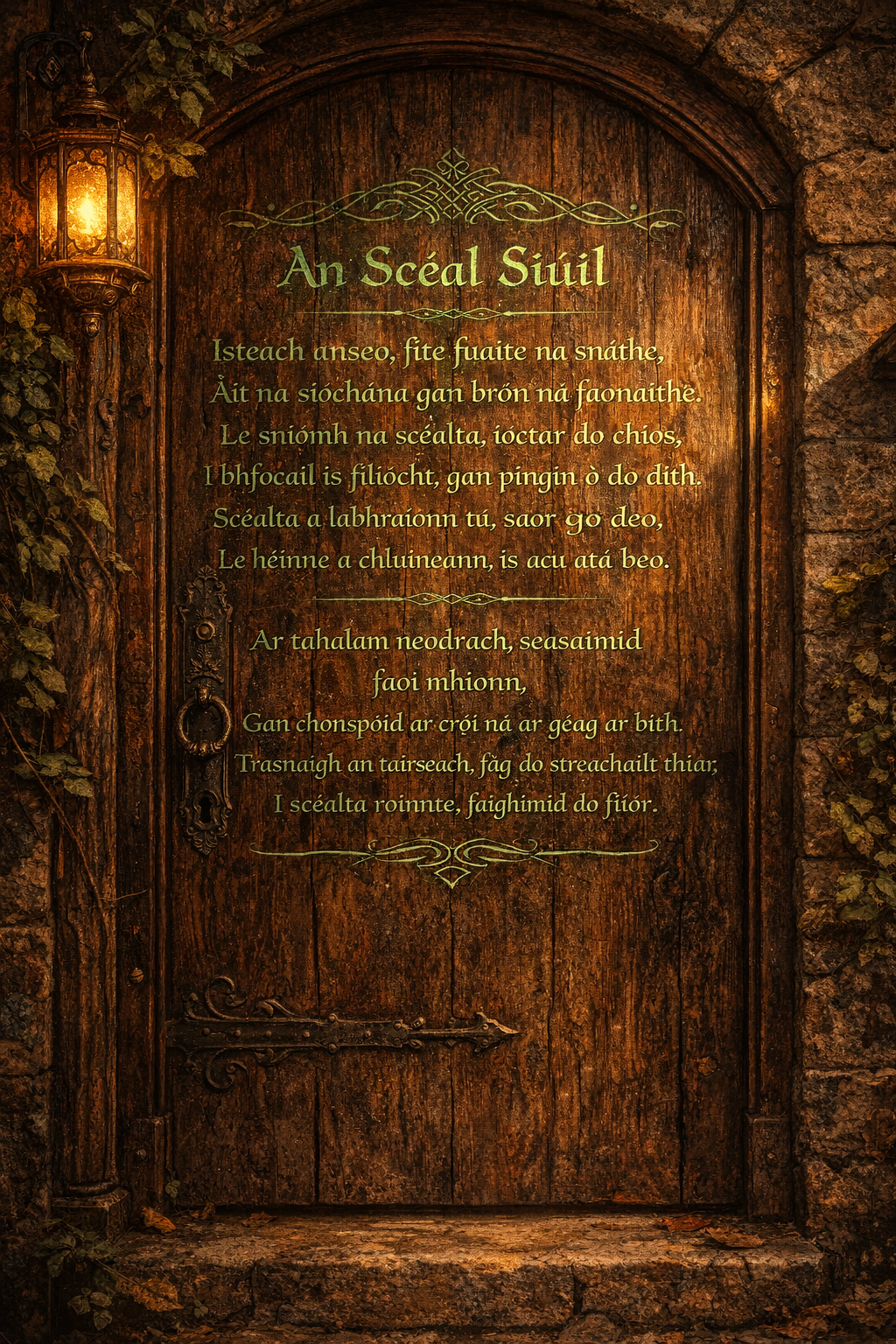

The door opens and for a moment nothing enters.
Jack looks up from the glass he’s polishing—an old habit, older than the tavern itself, something his hands do when his mind is elsewhere. The threshold stands empty. The Dublin street beyond is dark, pre-dawn, the torches not yet lit.
Then the boy is there. Not arriving—just there, as if he’d always been standing in the doorway and Jack had simply failed to notice.
He’s tall. Broad shoulders, the kind that come from years of training rather than mere growth. Seventeen, perhaps, or almost. Wearing a jersey that Jack doesn’t recognize—some mortal sport, numbers on the back, a name that Jack can’t quite read because it keeps shifting.
The boy steps inside. His footsteps make no sound on the Bodhi wood.
Zaquiel notices first. The vampire’s red eyes flicker in his shadowed corner, tracking the newcomer with the wariness of a predator who has learned that not everything that looks like prey is safe to hunt.
“Jack,” Zaquiel whispers. The word carries across the room the way whispers do in this place—heard by those who need to hear it. “What is that?”
Jack sets down his glass.
The boy approaches the bar. Up close, he’s harder to look at. Not ugly—handsome, actually, in the way of young athletes, all cheekbones and confidence. But his edges don’t stay where they should. His outline blurs and sharpens, blurs and sharpens, like a signal struggling to maintain coherence.
“Evening,” Jack says. His smile doesn’t stretch as wide as usual. “Or morning, I suppose. Welcome to my tavern.”
“Thanks.” The boy’s voice is steady, deeper than his face suggests. “Someone told me you collect stories.”
“I do.”
“I don’t know if I have one.” The boy looks down at his hands. They’re solid, then translucent, then solid again. “I don’t know if I’m… I don’t know what I am.”
Jack gestures to a stool. “Sit. Tell me what you do know. That’s usually enough.”
-----
Sub-Unit 72 processes from his usual table, data streaming across his perception in ways no mortal could parse.
Umbral entity. Tulpa classification. Coherence index: 0.43, fluctuating. Belief-sustained manifestation, source unclear. Pattern suggests—
He pauses. Runs the calculation again.
Pattern suggests dual-origin belief with contradictory vectors. Probability of stable existence under current conditions: 7.2%. Declining.
The Nexus unit rises and approaches the bar. Jack gives him a glance—not warning, exactly, but watchful. Sub-Unit 72 takes the stool beside the boy, maintaining what mortals would consider a respectful distance.
“You are being created and destroyed simultaneously,” Sub-Unit 72 observes. “The sensation must be considerable.”
The boy laughs. It’s a hollow sound, older than his face. “That’s one way to put it.”
“I am Sub-Unit 72 of the Iron Nexus. I state facts. It is my nature.”
“I’m—” The boy stops. His face flickers, and for a moment he looks younger, uncertain, like a child woken from a nightmare. Then he’s seventeen again, jaw set, eyes tired. “People call me Champ. My dad calls me that. Called me that.”
“And your designation? Your name?”
“I don’t…” Champ’s hands tighten on the bar. The wood under his fingers shifts between solid and intangible. “I had one. I know I had one. But every time I try to remember it, there’s just… static. Like someone erased it.”
Sub-Unit 72’s eyes flicker. “Someone is actively refusing to remember your name.”
“My mom.” The word comes out flat. “She can’t. She can’t hear it, can’t say it, can’t think it. It’s how she survives. So I can’t remember it either. Because I’m—” He gestures at himself, at his flickering outline. “I’m made of what they think of me. And she’s not thinking of me. She’s trying so hard not to think of me.”
-----
Jack pours something into a glass. The liquid is amber, warm, and when he slides it across the bar, it leaves a trail of light on the wood.
“Drink,” he says. “You’re solid enough to drink, at least for now. And it helps.”
Champ takes the glass. His fingers stabilize around it, as if the act of holding something real makes him more real in turn. He drinks. His eyes widen slightly.
“What is that?”
“Mead. Old recipe. Older than most countries.” Jack leans on the bar, his too-wide smile softening into something gentler. “Tell me about your father.”
“He…” Champ stares into the glass. “He comes to my room. Every night. Sits on my bed—my old bed, my real bed, back in the house. And he talks to me. Tells me about his day. Asks me what I think about the new quarterback, whether I’ve been watching the games. He knows I’m not there. I think he knows. But he talks anyway.”
“And you hear him?”
“I feel him. When he’s thinking about me, when he’s really focused on remembering me, I’m… more. I can feel my own heartbeat, almost. I can remember things—the weight of a football, the smell of the locker room, the way Coach used to yell.” Champ’s voice cracks slightly. “Dad remembers me so hard that I can almost remember myself.”
“And your mother?”
The glass in Champ’s hand flickers. For a moment it passes through his fingers, clattering on the bar. Then he’s holding it again, solid, but shaking.
“She’s in the next room. When Dad’s talking to me, she’s in the next room, and she’s not-thinking so loud I can hear it. Like silence that screams. She’s saying he’s gone, he’s gone, he’s gone over and over, and every time she says it, pieces of me—”
He stops. Breathes. The breath fogs slightly in the air, which shouldn’t be possible in the tavern’s warmth.
“I’m killing her,” he says quietly. “By existing. Every time Dad makes me real enough to feel, she feels it too. She doesn’t see me, she won’t let herself see me, but she knows something’s wrong. She knows the house isn’t empty the way it should be. And it’s tearing her apart.”
“Have you considered,” Sub-Unit 72 interjects, “revealing yourself to her? Eliminating the contradiction? If both parents believed in your existence, your coherence index would stabilize significantly.”
Champ’s laugh is bitter. “You think I haven’t thought about that?”
“I am inquiring as to why you have not acted.”
“Because it would destroy her.” Champ turns to face the Nexus unit fully. His eyes are dark, and for a moment they’re not the eyes of a teenager but of something much older, something that has had too much time to think. “She built herself back up out of nothing. After I died—after the real me died—she was gone for months. Couldn’t eat, couldn’t sleep, couldn’t function. Dad fell apart loud and she fell apart quiet and they almost didn’t make it.”
He looks back at his glass.
“But she did make it. She made it by deciding I was gone. Really gone. Completely gone. That’s the foundation she rebuilt her life on. If I take that away from her—if I prove that I’m still here, that she’s been denying her own son for years—”
“She would need to reconstruct her entire psychological framework,” Sub-Unit 72 completes. “The probability of successful reconstruction is low. The probability of catastrophic destabilization is high.”
“Yeah.” Champ’s voice is barely a whisper. “So I stay hidden. I let her not-see me. I let her erase me, piece by piece, because the alternative is watching my mom die.”
-----
Jack is quiet for a long moment.
The tavern has grown still around them. Zaquiel’s red eyes burn low in his corner, watching. A fey woman at a far table has stopped her conversation mid-sentence. Even the fire in the hearth seems to have dimmed, the Hell-stone beneath it dampening its crackle to a murmur.
“You came here looking for something,” Jack says finally. “Not just to tell your story. You want something.”
Champ nods slowly. “I want to know if there’s a way out. A way to exist that doesn’t hurt either of them. A way to be real without destroying her or unreal without abandoning him.”
“You’re asking if you can resolve a paradox.”
“I’m asking if I have to stay a paradox forever.” Champ meets Jack’s eyes. “I’m asking if there’s any version of this where I get to just… be. Without being a wound in someone I love.”
Jack doesn’t answer immediately. He reaches for his lantern—it’s in his hand suddenly, without transition, warm and steady—and holds it up. The light bends toward Champ, studying him, and for a moment the boy is fully solid, every detail crisp and clear.
Then the light pulls back, and the flickering returns.
“I don’t have an answer for you,” Jack says. “Not tonight. But I can offer you this: the Nexus brass in my walls remembers everything spoken here. Every time you visit, every fragment of your story that you share, it’s recorded. Preserved. Even if you dissolve entirely—even if your mother’s denial finally wins—some part of you will persist here. In my archive. In my walls.”
“That’s not existence.”
“No. It’s memory. It’s the next best thing.” Jack’s smile is sad. “Sometimes that’s all any of us get.”
Champ is quiet. He finishes his mead, sets down the glass, and stands. He’s more solid now than when he entered—the telling has given him coherence, at least temporarily. The story has made him real in a way his parents’ conflicting beliefs cannot.
“Can I come back?” he asks.
“My door is open to anyone with a tale to tell. And yours isn’t finished yet.”
“I don’t know how it ends.”
“Neither do I.” Jack’s grin widens, just slightly. “That’s what makes it interesting.”
-----
Champ walks to the door. His footsteps make sound now—soft, but audible. The Bodhi wood recognizes him as real enough to affect.
At the threshold, he pauses. Looks back.
“My name,” he says. “If I remember it—if I ever remember it—I’ll tell you. I’ll tell everyone here. I want someone to know it. Someone besides my parents.”
“I’ll listen,” Jack says.
“We will record it,” Sub-Unit 72 adds.
Champ nods. Then he steps through the door into Dublin’s pre-dawn darkness, and for a moment he’s silhouetted against the streetlights—tall, broad-shouldered, unmistakably real.
Then he flickers.
Then he’s gone.
-----
Zaquiel drifts to the bar, his shadowed form coiling into something almost solid.
“Umbral,” he says. It’s not a question.
“Tulpa,” Jack confirms. “Sustained by his father’s belief. Eroded by his mother’s denial. Caught between.”
“I have seen Sheol fall. I have seen Stambhana freeze. I have watched Realms die.” Zaquiel’s red eyes dim. “I do not think I have seen anything quite so cruel as that boy’s existence.”
Jack picks up the empty glass. It’s still warm from Champ’s hands—or whatever Champ has instead of hands.
“He’ll be back,” Jack says. “His story isn’t done. And every time he comes, the brass will remember a little more of him.”
“Is that mercy or torture?”
Jack considers the question. He holds the glass up to the light, watching amber residue catch the lantern’s glow.
“I haven’t decided yet,” he admits.
The fire crackles. The brass fixtures gleam, etching words into their substance that no one will read until someone asks.
And somewhere in Dublin, a boy who is and isn’t walks streets that may or may not notice his passing, carrying a name he cannot remember and a story he cannot finish, loved into existence and denied into dissolution, one heartbeat at a time.
-----
The boy called Champ has visited Jack’s Tavern seven times as of this record. His coherence index, as measured by Sub-Unit 72, has declined from 0.43 to 0.31. His father continues to believe. His mother continues to deny. The Nexus brass in Jack’s walls contains approximately 34% of his complete narrative. The remainder is still being lived—or unlived—one night at a time.