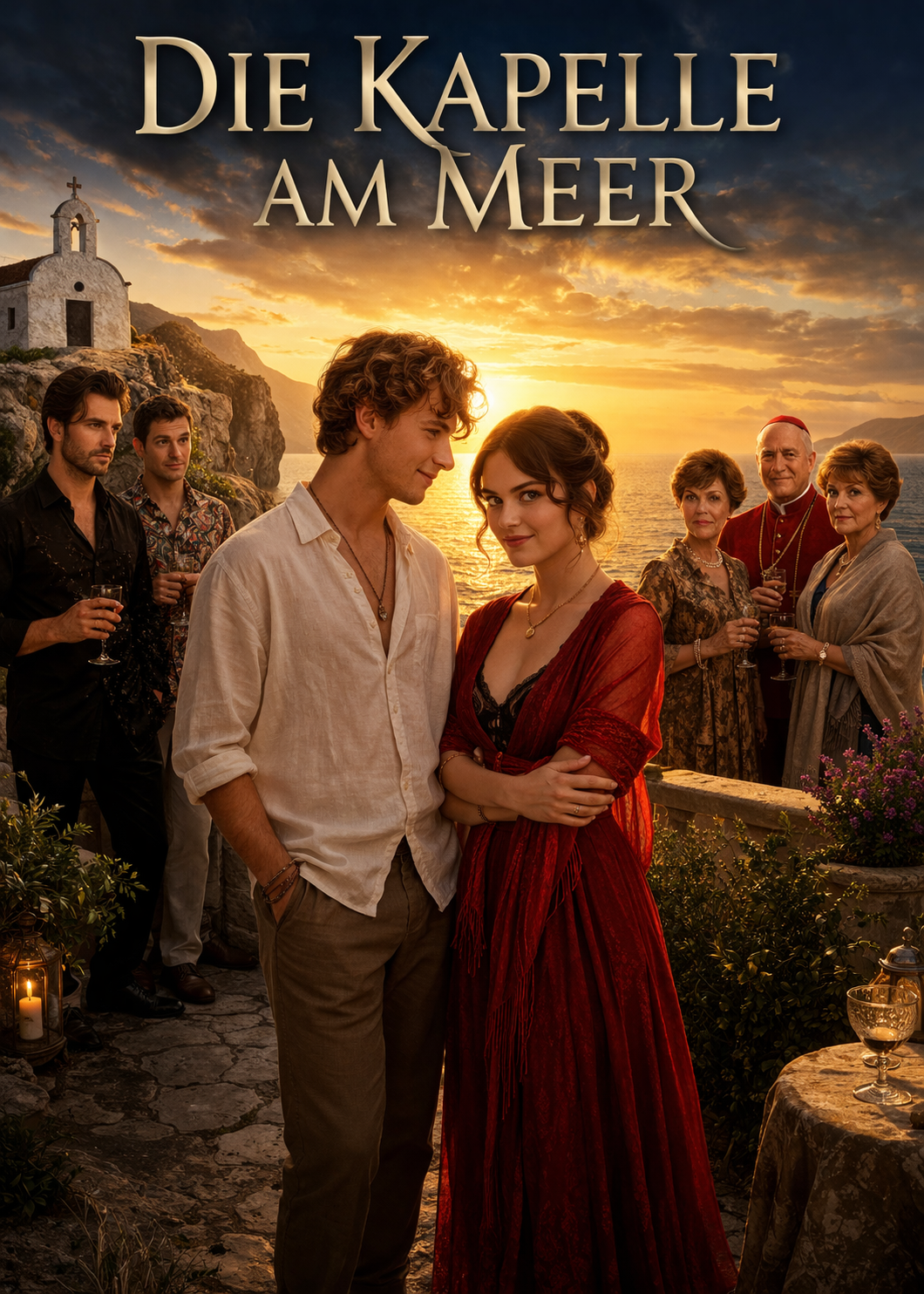

When Brian, Justin and Emmett stepped onto the terrace, the garden was completely full for a moment, without feeling too crowded.
Vittorio stood near the balustrade, Mary beside him, Fiona and Meghan a little further back. Justine stood between her family and her friends. Lito had quickly come to terms with the aperitif; Wolfgang was examining the bowls of olives as if he had to decide whether they were a luxury or simply food; and Sun stood where the moonlight formed a circle amongst the shadows of the lemon trees.
Bianca handed Brian a glass.
“Thank you,” said Brian.
“You’re welcome, Signore.”
Emmett took his glass with considerably greater reverence. “I’d like to point out that I’ve never been so pleasantly intimidated.”
Justine shot him a sidelong glance. “Wait until dinner.”
Down on the water, a motor grew quieter. Then the familiar sound of a small boat mooring was replaced by something else: the steady rhythm of oars, wood in the oarlocks, voices falling into place.
Vittorio turned round.
“Ah,” he said. “My young guests.”
Mary looked down towards the bay. “More of them?”
“Just to say hello. They’re camped on the neighbouring island. I’ve given the Leopoldine Military Grammar School permission to set up its ‘Camp Greece’ there.”
“Military grammar school?” Brian looked at Justin. “Of course. What would a Catholic aperitif be without cadets on a barge?”
“Austrian cadets,” added Vittorio.
“That makes it particularly special – and certainly multilingual.”
Meghan instinctively moved closer to the balustrade. Fiona, too, was now looking down. The water below the garden was dark, but the barge had lanterns at its bow and stern. Their light shimmered on the waves. The boat was wider than the small motorboats and sat more steadily in the water. It was moored off the jetty, just far enough away that the group on the terrace could see everyone.
The cadets stood in two rows. They wore gold skirts or trousers, with lilac-coloured jackets and hats over them. The leader stepped forward as soon as the barge was securely moored.
“Cadet Lorenz Mehlstaub,” said Vittorio quietly. “A very serious young man. Just right for his age, full of ideas and artistically gifted, but slightly multidimensional and unfocused.”
“There are four cadet colleges in Australia, but none with girls,” said Mary.
Vittorio raised his hand as a signal that they could begin.
Mehlstaub bowed towards the terrace. His voice was clear but confident.
“Your Eminence, ladies and gentlemen. The Lynx Year Group of the Leopoldine Military Grammar School would like to thank you for your hospitality on the neighbouring island and takes the liberty of presenting an evening greeting.”
Emmett leaned over to Justin. “Lynx Year Group. I want a coat of arms straight away.”
Justin didn’t take his eyes off the barque. “I’m sure they’ve got one.”
“I’m already feeling quite ‘Luchs-like’.”
Mehlstaub turned briefly towards his group. The names weren’t called out individually across the terrace, but Justin caught a few because the order of the row made them almost visible: Baueregger, Disep, Götz, Ivancsics, Ledermüller, Mehlstaub, Neuner, Rauscher, Rozsenich, Stanic and Wächter.
In the second row stood the female cadets: Auerbäck, Brunner, Dopona, Fahrner, Gallos, Holzer, Krenn, Maerschalk, Seidl and Wasinger.
They looked like young people who’d been taught to stand to attention, speak in ten languages and, whilst doing so, to stride through the world like moving letters spelling out the name ‘Austria’.
A dark-haired cadet stepped forward. “In memory of Cardinal Rauscher,” he said, “who gave the Church in Austria its form, its voice and its significance within the state.”
Vittorio bowed his head slightly.
The cadet spoke the first sentence in German, clearly and solemnly.
“Education without a conscience is merely a more skilful temptation.”
Neuner replied in English: “Discipline is not the enemy of freedom, but its first difficult grammar.”
Then Auerbäck followed in French, in a clear voice: “La foi ne doit pas craindre l’esprit; elle doit craindre seulement la lâcheté.”
This was followed by Russian from Götz. Wolfgang raised his head slightly as one of the cadets spoke with surprisingly clear pronunciation. Sun looked over at him and noticed the small, involuntary nod of approval on his face.
Finally, Ledermüller spoke in Greek. It was perfect, so well-rehearsed that the boatman down at the jetty smiled and nodded in approval. The sentence was long, more of a greeting than a quotation from Cardinal Rauscher. Peace to the house, thanks to the host and honour to the dead.
Meghan lowered her gaze at the last word.
Vittorio was silent for a moment before replying. “I thank the Luchs year group. And I’m particularly grateful that you’ve made an effort with four languages without mistreating a single one of them. That’s rarer in diplomacy than one might think.”
A soft chuckle rippled across the terrace and the barge. The tension that had hung over the garden since the guests’ arrival dissolved for a few breaths.
“Do they really teach English, French and Russian there?” asked Brian.
“And Greek, Latin and ten other languages,” said Vittorio. “If young people are to be sent to islands, they should learn more than just botany.”
Emmett was thrilled. “I should have gone to a school like that.”
Brian looked at him. “You’d have survived four days there.”
“With the right vocabulary, I’d have lasted much longer.”
Mary looked at the barge with scrutinising curiosity. “That’s a lot of names for a boat.”
“There are a lot of families for one country,” said Vittorio. “Austria likes to keep things complicated.”
Wolfgang picked up his glass. “At least it’s a country, even if it does have many languages.”
Sun was only half listening. She liked the cadets’ uniform demeanour, because young bodies, practising together, ceased to seem uncertain for a moment. She looked down at the small open space behind the house, which she’d noticed on her way up. A courtyard of light-coloured stone, sheltered by three walls. Quiet enough.
She waited until Vittorio had finished his greeting, then took a step towards him.
“Father Vittorio?”
He turned to her warmly. “Yes, Miss Bak?”
“Would it be possible to use the little courtyard behind the house later on? For some meditation exercises. Just for a short while. It’s a quiet spot.”
Vittorio nodded immediately. “Of course. As long as no one tries to put Catholic statues in the lotus position.”
Lito smiled. “That would be my job.”
Sun tilted her head slightly. “Thank you.”
Mary had heard the request. “Meditation?”
“Yes.”
“At a funeral service?”
Sun looked at her calmly. “Especially then.”
Mary said nothing in reply.
Down on the barge, the order of the service was winding down. The young people were talking more quietly amongst themselves; some were laughing; one leaned towards a female cadet and pointed up at the house. The farewell was over, but no one left straight away.
Vittorio set his glass down.
“If you’ll excuse me for a moment.”
“Are you going down?” asked Fiona.
“Yes. I promised them baklava.”
“That’s certainly valuable from a glycaemic point of view,” said Emmett. “May I come along?”
“Gladly. Honey and sugar are a very underrated form of pastoral care.”
Vittorio and Emmett headed for the stairs. Bianca had already appeared with a large, flat tin, neatly lined with a cloth. He took it from her, but she also handed him a smaller bag.
“For those who claim they don’t like honey,” she said.
“So, for the pistachio lovers?”
He walked down the stairs. On the terrace, everyone followed him with their eyes. The black robe moved between the light-coloured walls, was briefly swallowed up by the shadows and reappeared in the light of the lower lantern.
Justin joined Brian at the balustrade.
“It looks like a painting,” he said.
“Everything here looks like something you might have painted.”
“And do you like it?”
“I like that it works.”
Emmett joined them and rested his hands on the balustrade. “I like that a cardinal personally comes down to bring baklava to the cadets. It’s so European and charming.”
Down below, Vittorio had reached the jetty. Mehlstaub was standing up straight again, though the others were less stern than before. Some leaned forward as the tin was opened. The scent of honey, nuts and butter seemed to waft all the way up to the terrace, perhaps because everyone was expecting it.
Vittorio said a short prayer. Not loud enough for every word to be heard upstairs. Then he made the sign of the cross over the barque and the young people bowed their heads. Even the more restless among them stood still for that moment.
Afterwards, he handed out the baklava.
It took longer than it should have, because he spoke briefly to each of them. Mehlstaub was the first to receive a piece. Then came the cadets in the two rows. The order was maintained, but it softened.
Finally, Fabio Disep stepped forward. Until then, he had been standing next to Mehlstaub, holding a bottle in both hands. He handed it to Vittorio with visible solemnity.
“Your Eminence, as a token of thanks from the year group. A Styrian Uhudler. Not quite liturgical, but honestly crisp.”
Vittorio took the bottle and examined the label by the light of the lantern.
“Fabio, if a drink is honest, it is sometimes closer to the liturgy than perfumed, artificial products from a chemical factory.”
A few people laughed. Disep bowed contentedly and briefly stroked his imaginary beard.
On the terrace, Mary raised her eyebrows. “Uhudler for a cardinal.”
“I like Austria,” said Brian. “It doesn’t always seem to know whether it wants to drink whilst praying or pray whilst drinking.”
Wolfgang looked at him. “That’s not a contradiction.”
Lito raised his glass. “Nor does it in Mexico.”
Sun was no longer looking at the barge, but at the chapel above them. For a moment, the evening had taken on an almost innocent order: young voices on the water, honey biscuits, a blessing, laughter in the wind. But the courtyard behind the house remained in her mind: friendly, bright, quiet and sheltered from the wind.
A place where one could sit.
Down below, the barge cast off from the jetty. Vittorio stood by the water for a moment longer, the bottle of Uhudler in his hand, and watched it sail away. Then he turned round and slowly made his way back up the stairs.
Bianca was standing in the open doorway of the house. Behind her was warm light; in front of her, the garden. She wasn’t looking at the barge. She was looking at her watch.