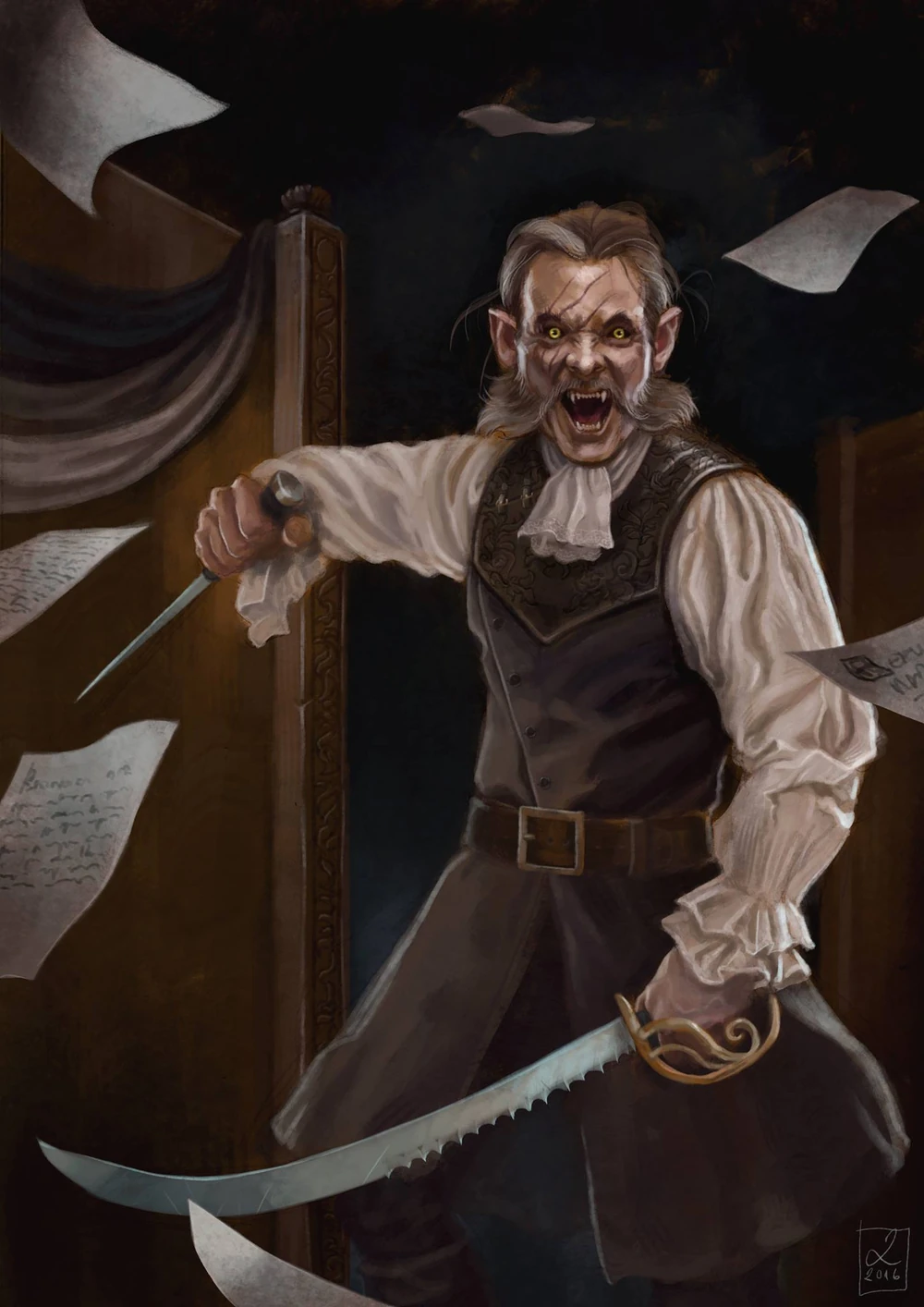

From Albrecht Lubens' Hagiography of Hermann Henscher
The Great Hall of Justice in Eustata, on the Ninth of Felinoz, Year XX, was filled to its utmost capacity.
Save only two low, coarse, and exceedingly uncomfortable wooden benches, standing in the very centre and facing the semicircular table where sat the ten People's Representatives composing the Judicial Committee of the National Assembly; and one solitary chair, raised upon a platform to the very level of the judges' table, towering on the right of the prisoners' benches. To the left stood the clerk's table. There existed neither place for prosecutor nor defender. Above the tribunal hung the Arms and Tricolour of the Republic, beneath the inscription:
THE PEOPLE'S JUDGMENT IS TERRIBLE, YET JUST.
On every other side the spectators rose in parterre and galleries, tier above tier.
Here, upon this very spot, Citizen Gelbs had once received sentence "for High Treason against His Majesty King Alphonse III"; nor had he stood alone. Scores had from these very benches gone forth, sacrificing themselves for the Republic unborn, to the Wheel, the Quartering, the Cutting-out of the Tongue, and those manifold torments which the diseased ingenuity of the old regime had devised against all who dared question the authority of kings.
Until the day when these Martyrs of the Republic shall be immortalized in the vast fresco destined to rise above the National Arms, one humble memorial alone recalls that gloomy history of the Hall: a simple arrow upon the President's table, pointing toward the Pavilion of Immortality.
In that portion of the audience behind the clerk's desk, level with the first gallery, there had been erected a ceremonial box unknown beneath hereditary Tyranny. It had been raised expressly for the victims of the accused, and for their families.
The Judicial Committee, however, having ordered that these should not enter until called to testify, lest the testimony of others influence their own, the seats within this honorary gallery had been distributed otherwise: to the painter Gaulus, charged with preserving the trial for posterity; to one representative of every parliamentary committee; to the President of the Quart Committee within whose jurisdiction the accused had resided before their arrest—that is to say, the district embracing the former royal Palace; and finally to Citizen Herman Hensher, not in his capacity as President of the Committee of Public Command, but as an honour due to the man who had first demanded that the proceedings begin without delay.
And seated within this gallery, whose place he had won by so glorious a title, Hermann Henscher succeeded, for one brief instant—a privilege rare indeed in his restless life—in leaving all anxiety and apprehension outside its walls.
His whole being burned with exultation.
The hour of Popular and Natural Justice, for which he had struggled through so many storms, had at last arrived.
He cast his eyes over the Hall.
The audience, ordinarily loud and overflowing with idle conversation, had fallen into an extraordinary silence while awaiting the entrance of the accused.
The Judicial Committee—Citizen Vernas himself had assured him of it—had taken care that the greater part of the assembly should be composed of friends of the prosecution, citizens whose fidelity to the Revolution had already been proved; men and women who, during the days of the Underground Republic, had at the least voted in its elections, if they had not served it with still greater devotion.
A fourth part of the seats, however, had deliberately been reserved for persons whose loyalty remained uncertain, that the spectacle they were about to behold might convince them of the Republic's irresistible strength; and that, returning home, they might carry the impression to neighbours and acquaintances, awakening in others those sentiments which every wise Government seeks to inspire.
The admission tickets had been distributed among every class of Eustatian society, though with a discreet preference accorded to journalists and artists, whose vocation it was to transform the event into words and images destined to mould the public spirit of the Republic.
Hermann Henscher knew well enough that among his own supporters intellectual men had always predominated—men of the pen, the lens, and the spectacles; educated, rational men; that respectable middle bourgeoisie which forms the thinking head of every Revolution.
The task of binding the artisans and peasants to the Republican Cause belonged rather to Citizen Schmeck, although among those classes superstition still maintained its strongest hold.
Henscher next regarded his comrades, the Revolutionary magistrates who shared the gallery with him.
Despite all differences—despite disputes, often bitter enough—he felt them this day to be united by a common friendship; for all had publicly declared themselves in favour of bringing the Afsens before the bar of National Justice.
They were bound together by the common destiny of the Revolution itself, and by dangers ascending to the highest conceivable degree: to these very prisoners' benches, to the executioner's table, to the Wheel itself, should Counter-Revolution prevail.
Unless indeed there sat among them some Royalist hireling, some traitor masking himself beneath Republican colours, even as many Republicans had once been compelled, under Monarchy, to wear the outward appearance of Royalists.
On Henscher's right sat Gaulus, quietly sketching in his notebook the details already present before the prisoners had even entered.
Hensher himself had requested this place beside the painter, that he might advise him upon the composition; nor had Gaulus, so far as Hensher knew, raised any objection.
"A dog," cried Hensher suddenly, with almost childish enthusiasm, though not a single dog was visible anywhere within the court. "Let there be one dog—and one only!—baring its teeth at the accused."
"And surely not a fox?" interposed Ostven at once, present on behalf of the Hrebsists, his hair even more disordered than usual, his garments still more threadbare, as though wishing by his very appearance to display contempt for those upon trial.
"The Fox belongs upon the Arms," replied Hermann impatiently. "But the dog—the dog!"
"It shall be done," answered Gaulus with the calm assurance of consummate mastery, his countenance, as always, illuminated by that unmistakable air of genius.
"There." He pointed toward the long narrow windows set high above the uppermost gallery, the sole source of natural light within the chamber. "Only its silhouette shall appear. Its shadow will fall across one of the accused—the worst among them."
"You are a great man, Citizen Gaulus," exclaimed Herman, unable to restrain his admiration. "The People will celebrate your name for centuries."
Nor was this praise undeserved.
From the days of the Underground Republic, Gaulus had placed his whole genius at the service of Liberty. He had painted the hidden institutions of the Revolution and its heroic actions, bestowing upon them that artistic consecration which mankind's natural love of the Fine Arts has ever demanded from every enduring political order.
Unlike those Sigisland painters so adored by nobles and fashionable dilettanti, Gaulus painted with severity, clarity, and simplicity. He represented reality as it was—without angels, without unicorns, without mythological apparitions; and within that severe truth he insisted always upon dignity, solemnity, and moral grandeur, which are, and ought ever to remain, the first characteristics of a truly Revolutionary Republic.
Acquainted as he was with the symbolism of the great masterpieces of Art, Henscher, had another painter stood before him, might well have feared lest some insidious emblem should be smuggled into the canvas, some hidden allusion proclaiming the pretended unworthiness of the Republic to sit in judgment upon "Princes." But of Gaulus there could be no suspicion. Neither the learned connoisseur nor the common spectator had ever discerned, in any work of that great master, aught save mighty and inexorable proclamations of Republican Truth.
"Citizens, what are we to do," spoke, in a grave voice from Ostven's left hand—left in place indeed, though by no means in politics—the deputy chief of the Masdenist parliamentary club, the historian and archivist Fregel, a man forever guided by what he conceived to be the categorical imperative, though always within the Masdenist doctrines of free commerce; "what are we to do if the superstitious, or those who would profit by ministering to the superstitious, gather up the objects upon which the blood of the Afsens shall have fallen after their destruction?"
The question startled Henscher for a single instant. He knew too well how many of his fellow-citizens—simple folk indeed, yet even some among the so-called respectable—still preserved within their homes relics stained with the real or imagined blood of the tyrant or of his kindred, beholding therein, or longing to behold, a safeguard against those horrors which habit and ignorance had transformed into spectres.
"Citizen Vernas has assured me," answered he, "that the destruction, should Fortune graciously permit it to come to pass"—and through Henscher's whole being there flashed that ardent hope that Fortune indeed would smile—"shall be accomplished in such a manner as shall prove not only the most moral with regard to the natural sentiments of the good and honest portion of the People, but shall also expose, once and forever, the foolishness of every superstition concerning royal blood."
"It shall prove it indeed—most gloriously shall it prove it!" cried Ostven, laughing aloud; and upon his countenance there passed, for a fleeting instant, an expression almost of good nature, strangely at variance with the image Henscher had long formed of that Hrebsist deputy.
Then the bell of the presiding judge, Citizen Vernas, rang forth. Instantly the hall sank into absolute silence.
Henscher felt the beating of his own heart.
The great hour of his life had arrived: the supreme ordeal of the Revolution itself.
"Guard! Bring in the accused."
Thus commanded Vernas, in a tone at once solemn and businesslike, almost expeditious.
Every eye turned toward the great door appointed for the prisoners.
The silence remained miraculous and complete. Such, Henscher hoped with all the fervour of his soul, was the reverence which filled the citizens of the Republic—not toward former Princes, but toward the righteous vengeance of offended Virtue.
What a moment!
With hands and feet unbound, yet visibly urged onward by the bayonets of the Assembly Guards pressing against their backs, the former princes of Guntreland entered the Hall of Justice. Step after measured step they advanced toward the prisoners' benches, toward that semicircular tribunal where Citizen Vernas sat enthroned in the President's chair—his eye covered by its bandage, his shattered legs rendered motionless by those very wounds which he had received for administering justice in the days when the tyranny of their house had granted them free licence to spill other people’s blood, as would presently once more be heard before this very tribunal.
And he himself—Citizen Henscher—whom these men named Arch-Usurper, for whom they reserved the cruellest torments, beheld it all from the ceremonial gallery; and little by little surrendered himself to that warmth of triumphant exultation, so rare and therefore so precious in his anxious existence.
His eyes sought eagerly every lineament of their countenances.
Clarence, the elder brother, once heir apparent, possessed, like his father—the tyrant afsen—a powerful jaw, a broad neck, and the frame of an athlete. Like his father also he wore a magnificent peruke, which had been permitted him even upon this occasion, as a testimony that freedom in attire belonged equally to every citizen of the Republic. Yet his expression differed from the father's. Where the elder Afsen's face had breathed severity, the son's suggested rather a strange mildness, a resignation toward the world and all its dispensations—even toward this very trial; and thus his mouth no longer drooped downward after the paternal fashion, but stretched almost in the straight line of composure.
Rupert, the younger, bore the features inherited from his mother's ancestors, former lords of one of those Oceanic Archipelagoes beneath the sovereignty of Guntreland; features visibly moulded by the perpetual winds that swept those distant isles: eyes somewhat oblique, a small nose almost triangular in its symmetry, thin eyebrows of pale brown. His hair and slight moustache were of the same colour. Upon his head likewise rested a heavy peruke, though less orderly than his brother's. His countenance betrayed a soul occupied less with the present trial than with the torments he imagined inflicting upon his judges in the hour of royal vengeance.
Both remained clothed in the very garments they had worn at their arrest.
Clarence still glittered beneath his silver mantle, clasped by a greyhound brooch upon the breast.
Rupert wore the broad white dolman whose skirts, sleeves, and deeply cut collar were embroidered with gilded flowers.
Henscher judged it well that they should appear invested in the attire of their former rank; for the trial of these men could never be separated from the trial of that rank itself. Whatever fragments of those garments might survive their destruction—if Fortune should so bless the Republic—would adorn the museums of the exalted res publica. Their excellent riding boots would soon serve some Republican soldier whose own feet now suffered within coarse wooden clogs.
The prisoners took their places.
Henscher believed he saw one of the Assembly Guards, partly for his own amusement, partly to win the favour of the spectators—perhaps even of certain public functionaries—thrust his bayonet once more into Rupert Afsen's back although the latter had already seated himself.
It seemed to Henscher that Rupert answered only with a sour and mocking smile.
Vernas fixed first one prisoner, then the other, beneath the lightning of his single eye.
From his colleague, Citizeness Bukholtz—a grave citizeness of middle years, with black hair and great spectacles, seated nearest him—he received a slip of paper, unfolded it, and began to read:
"First Accused: Rupert Afsen, aged thirty-four years; born at Schwenzstadt; formerly Prince; residing before his arrest at Republic Square No. 1, Eustata, and at Anti-Tyranny Boulevard No. 1, Schwenzstadt, having been apprehended at Hallstadt—let him answer to his name!"
"Prince Rupert, son of Alphonse the Third, King of Guntreland, lord of this land and of all you assembled here, who commands you—"
The words of Rupert Afsen vanished instantly beneath the clang of the President's bell and beneath the thunder of innumerable cries of "Boo!" rolling from every quarter of the galleries.
Henscher observed that Clarence himself motioned urgently for Rupert to cease speaking—a command to which, according to royalist protocol itself, the younger brother was bound to submit.
Thus at least one Afsen—and indeed the worse of the two—had chosen the path of insolence and arrogant pride before the Republican Tribunal.
So much the better.
By such conduct—which until now had served only the cause of the Republic—he deprived himself of whatever faint chance remained that the more indulgent members of the Judicial Committee might overrule Vernas and preserve Rupert's life.
From the galleries small objects now flew toward the accused.
No slight sacrifice this, in days when every coin might be transformed into some tangible necessity, above all into nourishing food.
Henscher resolved that, once the proceedings had concluded, these missiles should be collected and distributed among the invalids of the Revolutionary War.
He noticed, moreover, that his own hand had already wandered into his pocket in search of some remaining coin to hurl after the rest.
There was none.
Every last piece had already been spent upon food for the fox.
Yet Henscher observed that the Constitutional Guardsman had not, this time, pricked Rupert with his bayonet.
Was there cause for uneasiness in that omission?
Had even the Assembly Guardsman begun to fear the vengeance of Royalism? Or had he, perhaps, felt that involuntary respect which soldiers, by the strange fellowship of arms, are sometimes wont to feel toward a man who, even in the shadow of inevitable doom, dares bear witness to a false title with unshaken boldness?
Above all things, at this moment, Henscher longed for a sentence of condemnation and for the speedy destruction of the accused.
First: it would be the triumph of Justice over Injustice, such as the world had not beheld for—since the days when those monstrous creatures, the Dinosaurs, of whom it has lately become fashionable to discourse, wandered over the face of the earth; nay, perhaps from ages still more remote, from the very Creation itself. A triumph of Virtue over triumphant Crime; over that Crime which had rejoiced in its impunity, and even now seemed to rejoice in it still, persuaded that the accident of birth had purchased for it an eternal exemption from punishment.
Secondly: should the Republic accomplish this deed now, and in this manner—with the full participation of the National Assembly beneath whose authority the trial proceeded; of the Judicial Committee which administered it; of the Assembly Guard conducting the former princes at the points of drawn bayonets; of the assembled People whose acclamations sanctioned every step; of the whole City which tolerated and approved it; yea, even of the dogs themselves, those natural fellow-citizens and equal sons of the Republic of Guntreland—it would proclaim to all mankind that no awe remained for any false idol of Monarchy; that the Republic had become prepared, in truth as well as in right, to exercise Sovereignty over every being subject to her laws. More than this: it would proclaim that such a unity of destiny had been forged among Republicans that henceforth they must either live crowned with the glory of their common enterprise, or stand pledged, by this very act, to perish gloriously together.
"No unconstitutional titles!" commanded Vernas, glaring with undisguised wrath and hatred upon the First Accused.
Then, turning to the Second Accused—though higher in the Royalist order of precedence (for even the order of the indictment itself sufficiently testified to the Republican Tribunal's utter indifference toward Royalist hierarchies)—he pronounced:
"Second Accused: Clarence Afsen, aged thirty-six years; born at Schwenzstadt; formerly Prince, formerly Heir to the former Tyrant; residing before his arrest at Republic Square Number One, Eustata, and at Anti-Tyranny Boulevard Number One, Schwenzstadt, apprehended at Hallstadt—let him answer to his name."
"I am Prince Clarence Afsen."
Unlike his brother, the Second Accused spoke but these few words, rising courteously from his seat while naming himself.
Did Henscher suspect that the heir of an overturned throne and a shattered crown was preparing some subtle stratagem? Or did the President of the Committee of Public Command permit himself, secure in the conviction that the People's Tribunal was terrible yet just, to surrender for a brief instant to the enjoyment of a spectacle whose issue admitted, to his mind, of no uncertainty?
"No unconstitutional titles!" replied Vernas to Clarence also.
Then, casting his single eye alternately from one prisoner to the other, he recited from memory the severe formulas of that written Reason which was the law of the Republic:
"I instruct the accused that, pursuant to the Republican Code, persons charged with crimes against the Sovereignty of the Republic during the State of Emergency possess no right to counsel; for the innocent require no stronger defence than their own Sincerity, Republican Morality, and the sense of justice of the Republican Tribunal."
"Down with lawyers!" shouted Ostven from scarcely a meter distant from Henscher—that fearful child of the Revolution, that implacable hater of the bourgeois order.
His cry rolled through the hall and assuredly reached the ears of the members of the Judicial Committee, the greater number of whom had themselves belonged to the legal profession before the People had elevated them to the Assembly.
Laughter was heard from somewhere—Henscher fancied that even Rupert Afsen himself had smiled—but, to Henscher's satisfaction, still louder arose the prolonged hissing of "Sh-sh-sh!", such as impatient audiences direct against those who applaud between the movements of a solemn concert.
Vernas, intent upon his prey, ignored the interruption of the ungovernable representative.
The other members of the Committee, Henscher trusted, understood well enough how small a minority Ostven's doctrines represented among the Representatives of the People that they would feel no temptation, out of fear of such Revolutionaries, to preserve for themselves some avenue of retreat toward Monarchy by sparing the accused from destruction.
Nor was Henscher without consolation in another spectacle.
Those timid souls who trembled for their property beneath the new order might reassure themselves at the sight of Masden, seated in the foremost rank of one of the galleries, tranquilly enjoying, even amid these proceedings, some costly delicacy from a plate whose gilded rim glittered conspicuously in the light.
To Henscher such lavish indulgence appeared almost indecent; for the trial of the Republic's greatest enemies, no less than the enjoyment of a meal purchased by the labour of the cook and often by the sacrifice of a living creature, deserved the whole undivided attention of Man.
"I further instruct the accused," continued Vernas, declaiming from memory those beloved words which to himself, no less than to Henscher, were a guarantee that the proceedings should not drag themselves into interminable length, thereby breeding disorder, conspiracy, and intrigue; but rather that the destruction of the accused might be accomplished before this day's lunch—
"that, pursuant to the Republican Code, in prosecutions concerning crimes against the Sovereignty of the Republic during the State of Emergency, it shall not, for reasons of expedition, be necessary to hear witnesses for the prosecution whenever the Committee can otherwise satisfy itself of the guilt of the accused; and that whenever the Committee has attained conviction of their guilt or innocence, it may, likewise for reasons of expedition, terminate the proceedings forthwith, allow the accused their final word, and immediately pronounce judgment."
"We are all witnesses!" cried a woman from the upper gallery.
"We all bear witness that they are guilty! Guilty! Guilty!"
Approval burst from every side.
For nearly half a minute Vernas permitted the tumult to subside of its own accord before silencing it with the solemn authority of his bell, visibly gratified by the spirit of the assembly, while he, like Henscher himself, carefully studied the changing expressions upon the faces of those who had once been masters of life and death in the streets of Eustata.
"And finally," added the President, coming now to that provision which was the crown and safeguard of the whole proceeding—that guarantee that the Republic's trial of Monarchy should never be transformed into Monarchy's triumph over the Republic—
"I further instruct the accused that, should they by their conduct during these proceedings publicly manifest hostility toward the Republic or toward the Constitutional Order, the trial may instantly be suspended, and they may without delay be placed Outside the Law as active enemies of the Republic."
"Rupert has done so already!" shouted a man from among the spectators, as though Vernas and the Committee had failed to perceive it for themselves.
"To the dogs with them! To the dogs! To the dogs!"
The man sprang to his feet, swinging his clenched fist rhythmically in the air, plainly striving to awaken the multitude into a common chant.
But the rest of the audience, unwilling, it seemed, to delay the spectacle for which they had assembled, refused to take up his cry.
Whether he ought to rejoice at such restraint, or regret it, Henscher himself scarcely knew.
"Let there now reign the most solemn silence," commanded Vernas, dwelling deliberately upon every syllable in that aged voice whose echoes rolled through the vast Hall of Justice, striking against the framed Constitution, the Flag, the Arms of the Republic, and every heart therein assembled.
"For we proceed to the reading of the Indictment.
Citizen Clerk—read."