Part 1
Many winters had passed since Andren first opened his eyes beneath Thornhaven's silver boughs. He had counted fifty of them since the barrier rose—whether it had stolen them, he could no longer say with certainty.
He had been twenty-nine when the barrier rose. Fifty years had passed outside—he'd counted them. Seasons returned to the home he could never enter. Whether Thornhaven had experienced those same seasons, whether time inside the barrier moved at all, he could only guess. But the decay visible through the barrier suggested something had changed more than his absence. The wound remained, sealed and unexplained.
Silver threaded his dark hair at the temples. His hands bore the scars of countless camps, hunts, and solitary nights beneath comfortless stars. But inside—where grief lived, where memory calcified into something harder than bone—he remained twenty-nine. Still standing at that barrier. Still reaching for Zinnia's window. Still believing that if he could only find the right words, the right plea, someone would come to help.
No one had come.
The world had moved on. Thornhaven became a cautionary tale, then a rumor, then a name merchants mentioned when the fire burned low and the wine ran deep. Don't travel the Blackwood. The elves angered something old. The forest took them all.
Only Andren knew it had actually happened.
In the first weeks after the barrier rose, Andren believed someone would help him.
He walked three days west to the cottage where Mira lived at the forest's edge.
The journey took him through country he had known since childhood, but he moved through it without seeing much. He slept only when his legs failed him, waking beneath trees with Thornhaven's silence still lodged inside his skull. Whenever he stopped, he unfolded the sketches he had made of the barrier—the crooked symbols, the repeating lines, the places where silver light seemed to gather beneath its surface.
By the third morning, the parchment had softened along the creases from being opened too often.
Mira's cottage stood behind a wall of hawthorn and dangling charms. Bones, feathers, and bundles of dried herbs turned slowly in the cold wind. The hedge-witch had traded with Thornhaven for years—remedies for silver, herbs for coin. She knew the old ways. She would understand.
She met him at her threshold and would not let him cross it.
"The symbols you drew," she said, studying the sketches in his hands. "Those come from something older than the Crown. Older than the temples."
"Can you break it?"
Mira's eyes lifted to his.
"No."
"Can you tell me who can?"
She handed the parchment back without touching his fingers.
"Some doors shouldn't be opened, ranger. Some seals exist for reasons we've forgotten."
"The woman I love is behind that door."
"Then pray she stays there."
Mira stepped back and closed the door between them.
Andren remained on the threshold until the light disappeared from her windows.
He slept beneath the hawthorn hedge that night. By dawn, frost had formed along the edges of his cloak. Mira did not emerge.
He walked back to Thornhaven.
Three more days beneath lowering clouds. Three nights waking whenever branches cracked in the darkness, his hand already reaching for his bow. He ate little. The sketches remained folded inside his coat.
The barrier was unchanged when he returned.
Its surface shimmered faintly between the trees. Thornhaven waited beyond it, ruined and silent beneath a sky it no longer seemed to share with the rest of the world.
Andren walked the perimeter twice.
He called Zinnia's name until his throat hurt.
Nothing answered.
For two days he remained outside the apothecary window. He watched for movement in the darkened glass. Once, near dusk, he thought he saw a figure cross behind it.
He stood so quickly that his knees nearly failed him.
The window remained empty.
On the third morning, he left for Millcrest.
The road southeast had turned to mud beneath autumn rain. Merchant wagons passed him heading the other direction, their wheels sinking deep into the ruts. A few drivers raised hands in greeting. Andren did not answer. He kept one palm pressed against the sketches beneath his cloak, protecting them from the rain.
It took him six days to reach the city.
Millcrest's temple stood above the market district, its pale stone walls crowned by the golden sun of the Crown faith. Andren climbed the steps with mud dried to his boots and three nights' growth shadowing his jaw.
The attendants made him wait.
First in the outer hall, beneath painted saints whose faces had been polished smooth by incense smoke. Then in a narrow chamber where clerks carried stacks of parchment from one closed door to another. When Andren tried to explain why he had come, they told him Brother Aldric was occupied.
He returned the next morning.
Then the morning after that.
On the third day, Brother Aldric received him.
The priest sat behind a broad oak desk, his hands folded before him, clean and soft. He listened with the patience of someone performing a duty rather than offering comfort.
"The Arcane Council does not intervene in provincial matters without Crown authorization," Aldric said. "Thornhaven, while ancient, holds no strategic value. No trade routes. No military significance. The cost of an investigation would exceed—"
"There are people inside."
"Were," Aldric corrected gently. "The barrier has stood for weeks. Whatever happened there is finished."
"It isn't."
Aldric's expression did not change.
"I will note your petition in the temple records."
"I don't need it noted."
"That is all I can offer."
The priest stood, signaling the audience's end.
Andren did not move.
"There must be someone who understands the symbols."
"There are Crown surveyors who catalogue magical disturbances."
"Where?"
Brother Aldric hesitated, perhaps regretting that he had said even that much.
"A man named Garrett passed through the eastern district several days ago. He was mapping boundary stones along the river road."
Andren left before the priest could dismiss him again.
He spent the next four days searching.
Garrett had already left the eastern district. A stable boy remembered his horse. A tavern keeper remembered his complaints about the rain. A merchant said the surveyor had gone north to inspect an abandoned watchtower. Another insisted he had gone south.
Andren followed both roads.
On the fifth evening, he found Garrett in a riverside tavern two settlements beyond Millcrest, seated beside the hearth with his maps spread across a table. Mud stained the surveyor's boots, but his coat bore the brass clasp of Crown service.
Andren placed the sketches over Garrett's maps.
The surveyor looked at the wet parchment, then at Andren.
He did not pick it up.
"Elven village disputes aren't Crown business."
"It isn't a dispute."
"If your people angered something, that's between you and whatever gods you keep."
"The barrier covers half a mile. Arrows disappear when they touch it. Something is wrong with what's inside—how it decays, how the light moves. I don't know what."
Garrett took a drink.
"I don't investigate rumors."
"I watched it happen."
"Then you know more about it than I do."
Garrett pushed the sketches aside with two fingers. His other hand settled on the pommel of his belt knife—not a threat, but a boundary.
"Find someone else to bother."
Andren gathered the parchment.
The charcoal had begun to smear where rain had reached it. Several symbols were no longer legible. He stared at them for a moment, trying to remember the exact shapes.
Then he folded the sketches and put them away.
The journey back took eight days.
His food ran out on the fifth. He trapped a rabbit and ate half of it before the meat had cooked through. Rain followed him west, filling his tracks as quickly as he left them. At night he dreamed of Thornhaven's windows, each one lit from within, each one darkening before he could reach it.
By the time the barrier's silver curve appeared between the trees, nearly a month had passed since he had first gone seeking help.
Nothing had changed.
Thornhaven remained sealed.
The apothecary window remained dark.
Andren stood at the forest's edge with mud to his knees, the ruined sketches pressed against his chest, and understood at last what every mile had been trying to teach him.
No one was coming.
Not the hedge-witch who feared forgotten magic. Not the priest who measured lives against strategic value. Not the Crown surveyor who saw an elven village as someone else's problem.
He had crossed half the region carrying Thornhaven's lost in his voice, and the world had answered by closing one door after another.
Andren looked through the barrier toward Zinnia's window.
"I tried," he whispered.
The glass remained dark.
He was alone.
The perimeter had changed in his absence. Not the barrier itself—that remained as impenetrable as before—but the grass at its edge. Trampled. Disturbed. Signs of others who had come and tried and failed.
Where roots crossed the barrier's edge, black lines threaded beneath the bark, branching inward toward Thornhaven. Whether they marked the barrier's creation or its consequence, Andren could not tell.
He found Jorik's carved horse first, half-buried in the dirt where the western path met the barrier's curve. The toy was unfinished, the wood still rough in places. Jorik had been making it for his daughter. He must have been carrying it when he tried to breach the seal.
Old Gareth's silver ring lay near the northern edge, the metal bent as though someone had tried to force it through the barrier's surface. The elder's hands had been gnarled with age. He would have needed both of them to remove that ring.
Sera's blue ribbon—the one she wore when she braided bread dough in her mother's bakery—was caught on a thornbush twenty paces from the barrier. Sixteen years old. She'd been learning the old patterns, the ones that took years to master.
They had all tried. A hunting companion. The village elder. A baker's daughter barely old enough to be called a woman. They had come to the barrier and attempted to break through or slip past, desperate to reach whatever remained inside—if anything remained at all.
They had come here. They had tried. And whatever happened afterward had left no tracks leading away.
Andren knelt in the grass and gathered the abandoned things with shaking hands. The horse. The ring. The ribbon. A handful of earth from outside Zinnia's window, sealed in a glass vial he'd brought from his pack.
Each object was a name. Each name was a life the world would forget.
He understood then that if he died, these objects would become meaningless. Jorik's horse would be mistaken for any child's abandoned toy. No one would know whose window had stood above the earth in the vial. No one would understand that Sera's ribbon had been worn with pride by a girl learning her craft. No one would look at Gareth's bent ring and see the desperate strength it had taken for an old man to remove it.
So far as Andren knew, he was Thornhaven's last witness.
He heated his sewing needle in the campfire until it glowed. He had no mirror, no steady hand to guide him. He pressed the hot metal through his earlobe in one quick motion, biting down on leather to keep from crying out.
The pain was sharp and clean and somehow clarifying.
He threaded a length of silver wire through the fresh wound and twisted it into a ring. It settled against his jaw like an accusation.
Then he took the leather cord from his pack and began stringing the other pieces. Jorik's horse. Sera's ribbon. Old Gareth's bent ring. The vial of earth. Each one a name. Each one a person who had tried to reach Thornhaven and left no trace behind.
He tied the cord around his neck and felt their weight settle against his chest.
So far as he knew, no one else remained to carry their names.
Part 2
Three months into his isolation, Andren woke in his forest camp unable to remember Zinnia's face.
He knew her. The shape of her. The way she moved through the apothecary with quiet efficiency, her hands always busy with mortar and pestle, her voice soft as she explained which herbs would draw poison and which would ease pain. He remembered the scar on her chin from a childhood fall. The way she bit her lower lip when concentrating. The exact place on the ancient oak where they had carved their initials, the bark still pale beneath the cut.
But her face—the face he would have known in any crowd—was gone.
He found only darkness where Zinnia should have been.
Panic closed around his throat.
He tore through his pack, scattering supplies across the forest floor. Flint. Tinder. Dried meat. The sketches he had shown Mira, Brother Aldric, and Garrett, each one a monument to failed hope. His fingers found the leather cord heavy with charms: Jorik's carved horse, Sera's ribbon, old Gareth's bent ring, the vial of earth from beneath Zinnia's window.
Near the end hung a small bead of blue glass.
Zinnia had worn it in her hair. It had fallen loose one summer afternoon, and he had kept it, meaning to restring it for her. That was before Thornhaven. Before the barrier. Before the world had narrowed to silence and trees.
He lifted the bead into the dawn light.
The exact color of her eyes in summer.
Her face returned.
Not slowly. Not piece by piece. It struck him all at once—the intelligence in her eyes, the curve of her cheek, the small smile she wore when she thought he was not watching. She stood whole in his memory, so vivid that for one impossible heartbeat he expected to hear her speak.
Andren folded around the bead, clutching it against his chest.
He understood then what the charms were.
Not keepsakes. Anchors.
Without them, time would wear the lost smooth. Their voices would lose their shape. Their faces would become names, and the names would become nothing.
He heated his sewing needle over the fire until the metal glowed orange. When it was ready, he pressed it through his left ear beneath the first silver ring.
Pain flashed white behind his eyes. Blood ran warm down his neck.
He threaded a second length of silver through the wound and twisted it closed.
Two rings. Two promises.
The bead returned to the cord, closer to his heart than before.
By sunrise, the camp felt like a grave.
Andren broke it and headed south.
For three days he followed old logging roads and narrow tracks between settlements. Villages passed in fragments: timber houses beneath cooking smoke, children shouting through muddy yards, merchants selling winter apples and rough-spun wool. Mill wheels turned. Hammers rang. Doors opened and closed.
Life continued everywhere except Thornhaven.
Andren passed through it like a ghost.
People watched the silver in his ear and the charms at his throat. Mothers drew their children closer. A priest made a warding sign as he crossed a village square. Merchants accepted his coins without conversation.
He preferred it that way.
On the fourth evening, a man stepped from the trees ahead.
He was broad through the shoulders, with a cudgel in one hand and a knife in the other. Two younger men emerged behind him—thin, poorly armed, their hunger sharpened into something mean.
"That's far enough, friend."
Andren stopped.
The leader looked over his bow and pack. "Set those down. Coin purse too. Do it slowly, and you can keep walking."
Andren studied the three of them.
"No."
The word felt strange after days of silence.
The man's expression hardened. "Wrong answer."
He rushed forward, swinging the cudgel in a wide arc.
Andren stepped inside it.
His hunting knife cleared its sheath before thought could catch up. The blade slipped beneath the man's raised arm and entered between the ribs.
The resistance was different from hide. Softer. Warmer.
The brigand made a small, wet sound.
Andren pulled the knife free.
The man dropped to his knees.
For a heartbeat, no one moved.
Then Andren turned toward the others.
One held a rusted sword. The second gripped a woodcutter's axe in both hands. Neither raised his weapon.
"Go," Andren said.
They ran.
The wounded man pressed both hands against his side. Blood welled between his fingers and darkened the road beneath him.
"You—" he managed.
Andren walked past.
He did not look back. He did not learn the man's name. He did not wait to see whether the wound would kill him before morning. Behind him, the man's body struck the road.
The road stretched south, empty beneath the failing light. Blood cooled along the edge of Andren's knife.
He wiped it on his cloak and kept walking.
That night he camped in a hollow between two hills. He built no fire. He ate cold meat beneath an oak and listened to the wind move through its branches.
The brigand's face had already begun to fade.
He tried to hold the moment—the exact resistance of the blade entering, the warmth that had flooded his hand, the small sound the man had made. The weight of it. The realness of it.
But the details were already slipping away like water through his fingers.
The matted beard. The eyes. The shape of the mouth as the knife went in—he could almost see it, almost feel the memory of feeling it, but it was already becoming distant, unreal, like something that had happened to someone else entirely.
By morning, the man might be nothing more than blood on a road.
That frightened him more than the killing.
Because the killing had felt like something. For one moment, his hands had remembered what it meant to be alive—the shock of resistance, the heat, the terrible intimacy of taking a life. And now even that was fading, worn smooth by the same indifference that had claimed everything else.
He reached beneath his cloak and found the blue bead.
Zinnia's face returned at once.
The dead man's did not.
Andren closed his fist around the bead until its edges cut into his palm.
By dawn, he could no longer remember the color of the brigand's eyes.
Part 3
Months later, he found the proclamation nailed to a tree at the forest's edge, near the road that led to Millcrest.
The parchment was official Crown stock, sealed with the golden sun that marked all royal decrees. The ink was fresh enough that it hadn't yet begun to fade.
Let it be known that the settlement of Thornhaven is lost. By order of the Crown, the affected area is declared sealed and forbidden under penalty of law. Citizens are prohibited from entering the quarantine zone under threat of treason charges. Any person found attempting to breach the barrier or remove artifacts from the site will be subject to immediate arrest and trial.
By decree of His Majesty's Arcane Council.
Andren read it three times.
Then he tore it down, crumpled it in his fist, and walked away.
But the words settled into him like poison. The Crown hadn't just refused to help. They'd made Thornhaven forbidden ground. Entering it—even attempting to enter it—would be treason.
His last hope, the one he'd been carrying without acknowledging, died that day.
No one was coming. No one would ever come. And if he somehow found a way through the barrier, the Crown would arrest him for trying.
He walked deeper into the forest and didn't return to the road for two years.
Five years into his isolation, Andren discovered a village burning.
He'd been tracking a wounded boar through the western reaches when he smelled smoke. Not the clean scent of hearth fires, but the thick, acrid stench of thatch and timber going up in flames. The boar's trail disappeared from his mind. His bow was already in hand before conscious thought caught up, an arrow nocked, his body moving downwind through the trees.
The village was small—perhaps thirty buildings clustered around a central square. Smoke rose in black columns against the afternoon sky. Bandits had come in the night and remained into the afternoon. They were still there.
Andren counted them from the tree line.
Eighteen. Maybe twenty.
Three mounted—good horses, stolen or bought with blood money. Four archers positioned on the roofline of what had been the village hall, commanding the square and the northern approach. The rest were on foot: some loading carts with grain and tools, others kicking through doorways, dragging out anything worth taking. Bodies lay in the street. Not many. Most of the villagers had probably fled into the forest at first light.
But not all.
A woman was being dragged from one of the houses by two men. She was screaming, fighting, clawing at their arms with desperate strength. One of them hit her hard enough that she went limp. Her scream died with the blow. They began pulling her toward the square.
Andren was fifty yards out, perfectly positioned.
The wind came from the east, steady and cool, carrying smoke away from his position. The sun was behind him. The bandits were focused inward, on their plunder and their captive. His first shot would be clean. The second would have to follow before anyone understood where the first had come from.
He could drop both men before they knew death had found them.
His fingers found the fletching. The bow came up smooth as breathing.
The woman's head lolled as they dragged her across the dirt.
Andren's first arrow took the man on the left through the throat.
The bandit made a wet, choking sound and fell. His companion had time to turn, time to see the gray-cloaked figure at the tree line, time to reach for the woman as a shield—
The second arrow punched through his chest before his hand closed on her arm.
He dropped.
The woman lay still in the dirt between them.
For a heartbeat, the village seemed to pause. Then chaos erupted.
One of the rooftop archers turned toward the refugees huddled near the eastern edge—a mother, two children, an old man who'd been trying to shepherd them toward the forest. The archer's bow came up.
Andren's third arrow dropped him before he could loose. The man tumbled from the roof and hit the ground with a sound like a sack of grain.
A mounted bandit spurred his horse toward the fleeing family, sword raised.
Andren's fourth arrow took him in the shoulder, spinning him from the saddle. The horse bolted. The family ran.
His fifth arrow opened the eastern route—caught a bandit moving to block the tree line, sent him sprawling. The refugees didn't wait. They vanished into the forest, the old man half-carrying one of the children.
The woman in the square was crawling now, dragging herself toward cover.
The bandits were shouting. Pointing. Some scattered. Others dove for cover behind carts and walls.
Andren had six arrows left in his quiver.
Then someone on the rooftop shouted: "Tree line! East side!"
The remaining archers turned as one. Arrows began hissing into the woods around him—wild shots, panicked, but enough to make him move. Andren slipped sideways through the undergrowth, found new cover behind a fallen oak, nocked another arrow.
A bandit broke from behind a cart, running for the horses.
Andren's arrow caught him in the leg. The man went down screaming.
But the mounted bandits were moving now, spreading out, circling toward the forest's edge. They'd stopped looting. Stopped thinking about plunder. Now they were hunting.
Andren counted again.
Five arrows left. Perhaps fourteen bandits still standing. Two mounted, closing on his position from different angles. The archers had found their discipline—they were firing in sequence now, keeping him pinned while the riders flanked.
He could kill two more. Maybe three if the angles held.
Then they would have him.
The mathematics were simple. Brutal. Inescapable.
His fingers found the next arrow, but they were stiff now, clumsy. His heart hammered against his ribs. The bow felt heavier than it should. The hoofbeats were almost on him now.
Andren shifted position again, moving deeper into the trees. Through the smoke he saw an old man—not the one who'd fled, another—standing in a doorway with a woodcutter's axe, defending the threshold. Behind him, shadows moved. People still trapped inside.
A bandit approached the door, sword drawn.
Andren drew his bow.
The shot was there. Clean. Forty yards, slight elevation, eastern wind. He could take the bandit, give the old man a chance, give the people inside time to run—
If he loosed now, if he stayed to make the shot, the riders would be on him before he could nock again. They would run him down in the forest like the wounded boar he'd been tracking. His body would rot in the leaves and no one would know his name.
And Thornhaven—
The thought came unbidden, unwelcome, undeniable.
If he died here, who would remember the morning light across Thornhaven's square? Who would remember Gareth's hands mending things—the fence rails he replaced without being asked, the forge tools he sharpened until they caught light like water? Who would remember Sera dusted white with flour, her tongue between her teeth as she practiced the braids? Who would remember Jorik's laugh, rough and warm, always carving something for his daughter?
Who would remember Zinnia beneath the oak?
The charms against his chest felt suddenly, impossibly heavy. Jorik's horse. Sera's ribbon. Gareth's ring. The blue bead. The vial of earth from beneath Zinnia's window.
Someone had to remember.
Someone had to carry them forward.
Andren lowered his bow.
He backed away from his position, moving with the trained silence of five years alone. The old man in the doorway swung his axe. The bandit's sword came down. Andren didn't see what happened next.
He moved deeper into the forest, still controlled, still quiet, until the smoke concealed him and the sounds of battle faded to something distant and unreal.
Then his restraint broke.
He moved faster. Harder. Branches tore at his cloak. His breath came in ragged gasps. Behind him, someone was shouting—a voice calling for the archer, calling for him to come back, calling for help that would not come.
Andren kept walking.
He heard screams. Couldn't tell if they were villagers or bandits. Didn't stop to learn the difference.
By the time the forest swallowed the sounds completely, his hands had stopped shaking.
That night, he made camp where the smoke was still visible through the trees—a gray smudge against the darkening sky. He built a small fire. Ate dried meat and hard bread without tasting either. Cleaned his bow with methodical care, checking the string, examining the limbs for cracks.
Then he counted his arrows.
Five remained in his quiver. Six were gone.
Six arrows. Three men dead. Perhaps four. Two more unable to pursue. The woman saved. The family with the children. The old man who'd shepherded them. Perhaps a dozen villagers escaped because he'd opened the eastern route.
It should have been enough.
It wasn't.
He sat by the fire and tried to hold the moment—the exact resistance of the bowstring, the flight of each arrow, the sound of bodies hitting earth. The woman crawling through the dirt. The old man in the doorway, axe raised, defending people whose names Andren would never know.
But the details were already slipping away, worn smooth by the same indifference that had claimed everything else.
By morning, he could barely remember the village's layout.
By the following week, he couldn't recall the woman's face.
But he remembered the hoofbeats closing in. The mathematics of his own death. The weight of the charms against his chest and the terrible clarity of understanding that if he died, Thornhaven died with him.
He heated his sewing needle in the fire until it glowed.
This time, he pierced his left eyebrow—not the ear, where mourning rings belonged, but somewhere visible. Somewhere he would see every time he caught his reflection in still water.
The mourning rings belonged to those taken from him.
This mark belonged to those he had abandoned.
It belonged to the moment he had called fear remembrance and walked away.
The woman he'd saved told the story first.
She remembered arrows emerging from smoke. Bandits falling. A gray-cloaked figure at the tree line, barely visible, almost ghostly. The eastern route opening. Villagers escaping into the woods.
She never saw him leave.
The story she told was simple: A gray-cloaked ranger struck six raiders and saved the village.
But stories don't stay simple.
As the tale moved between settlements, the numbers grew. Six bandits became twenty. The archer opening one path became him leading every survivor to safety. Other deeds attached themselves to the same figure: hunters freed from snares, missing children returned, traplines mysteriously disarmed. Every unexplained mercy became his work.
The patched gray cloak became the defining image.
They called him the Gray Ranger.
Years later, Andren heard the name in a tavern in Millcrest. He'd come for supplies, moving through the market like smoke, and stopped outside the common room when he heard a merchant telling the story.
"The Gray Ranger stood alone against twenty men," the merchant said, his voice carrying through the open window. "Drove every last one from the village. They say he never misses. Never hesitates. Never abandons those who need him."
Andren stood in the street, frozen.
He recognized the details. The burning village. The woman dragged from her house. The eastern route. The gray cloak.
He knew exactly how many arrows he'd fired.
He knew what he'd heard when he left.
He knew the truth the story had buried.
Someone inside the tavern asked: "Have you seen him?"
"No one sees the Gray Ranger," another voice answered. "He's a ghost. A legend. Some say he's not even human—that he's something older, something the forest sent to protect the innocent."
Andren walked away before he could hear more.
He never corrected the story. Correcting it would have required admitting what really happened—that he'd saved some and left others behind, that he'd opened an escape and then fled through it himself, that he'd chosen Thornhaven's memory over the living people before him.
The silence allowed the legend to grow.
And the legend—the false, heroic version of himself—haunted him far more than any truth.
After that, he spoke only when necessity demanded it. The few times he ventured near settlements, he communicated in gestures and silence. The forest's older languages consumed him—the speech of wind through branches, the grammar of animal tracks, the syntax of seasons turning. Both elven and human words became foreign things, clumsy and unnecessary.
His body remembered skills his mind had wanted to forget. He could track wounded game across bare rock. Could shoot in darkness and wind. Could move through the forest so quietly that deer didn't startle until his arrow was already in flight.
But this mastery served only isolation. He hunted to survive. He survived to hunt. Each year blurred into the last. Five years became ten became twenty. The circle closed around him like a noose.
The years compressed.
Discipline became obsession. Isolation became identity. The charms around his neck grew heavier—not with new additions, but with the weight of time. Each object a ghost made tangible. Each piercing a mark of the man he'd chosen to become.
People saw him only in fragments: an arrow appearing from nowhere; a tall figure moving between trees at dusk; horses freed from snares while their owners slept.
The name traveled farther than he did.
He heard fragments of it whenever necessity drew him near civilization—another rescue credited to him, another impossible shot, another village he had supposedly saved. The Gray Ranger grew with every telling while Andren disappeared further beneath the weight of him.
He knew only the forest, the seasons, the endless repetition of survival. His hair turned silver at the temples. His hands grew scarred. His eyes—once warm, once capable of softness—became the color of winter sky, distant and unreadable.
Seventy-nine winters. Fifty of them alone.
By elven standards, he was still young. By any measure that mattered, he was ancient.
Part 4
Millcrest announced itself through sound before sight—the clatter of cart wheels on cobblestones, the calls of merchants hawking wares, the general din of humanity pressed together in streets too narrow for the crowds they held.
Andren kept his hood up, his eyes down. He moved through the market like smoke, drawing glances but no conversation. The charms around his neck clicked softly with each step. The piercings caught the light.
He needed supplies. Salt. Bowstring. A new whetstone. The forest provided most of what he required, but some things could only be found in settlements, and Millcrest was large enough that he could move through it without drawing too much attention.
A merchant selling leather goods looked at him twice, then looked away quickly. A woman with a basket of apples stepped aside to let him pass, her expression carefully neutral. Children stared until their parents pulled them close.
He was used to this. Had been for years.
He was examining whetstones at a tool-seller's stall when he heard the commotion.
Raised voices, in the distance. Something heavy hitting wood. A woman's cry—not quite a scream, but close.
The sound struck him like a fist.
For one disorienting heartbeat, smoke filled his lungs where there was none. An old man stood in a burning doorway, and somewhere behind him a voice called for the archer to return.
Not again.
Andren's hand moved to his bow without conscious thought. His feet were already moving toward the sound.
Some instincts, it seemed, ran deeper than choice.
The alley was narrow enough that two men couldn't walk abreast. Andren saw the scene in fragments as his eyes adjusted to the shadows.
Three men. Rough clothes, weapons poorly maintained but functional. One had a knife. Another a cudgel. The third was unarmed but large enough that it didn't matter.
They were spreading out, positioning themselves to flank.
Between them and the alley's dead end: a young woman, perhaps twenty. Her dress was fine enough to mark her as merchant class. Her face was pale.
And standing over her: a figure with a shield and a drawn sword.
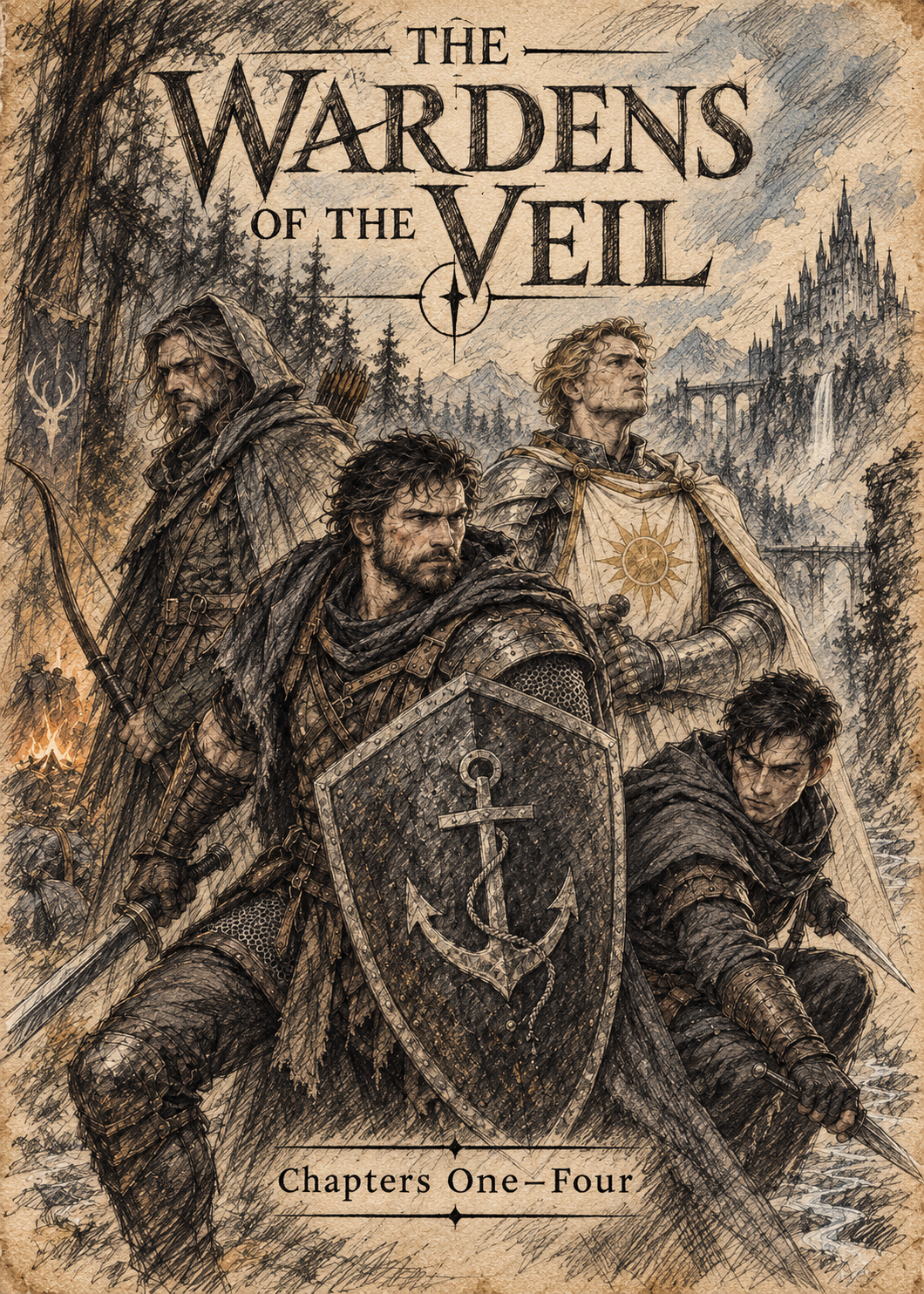
The shieldman was broad-shouldered, scarred, his stance that of someone who'd fought too many battles to count. His shield bore a crest Andren didn't recognize—an anchor on black iron. His sword was notched but well-kept, the blade angled toward the woman.
From where Andren stood at the alley's mouth, the angles were wrong. The woman was pressed against the wall. The shieldman loomed between her and escape. The three others were closing in—but slowly, carefully, as though approaching something dangerous.
The shieldman was the predator. The woman was the prey. The three men were trying to stop him.
Andren's arrow was nocked before the thought finished forming.
He didn't call out. Didn't warn. Didn't wait.
The arrow flew.
It caught the shieldman high on the cheek, just below the eye—a red line opening across scarred skin. The man's head snapped back. Blood ran down his jaw.
For one frozen heartbeat, everyone in the alley went still.
Then the three men bolted. They didn't look back. Didn't hesitate. Just ran, their footsteps echoing off stone as they disappeared into the street beyond.
The shieldman's head turned slowly toward Andren. His eyes were cold, calculating. Blood dripped from his chin onto the cobblestones.
"You just made a mistake," he said quietly.
Then he charged.
Andren dropped his bow and drew his knife. The alley was too narrow for arrows now, too close for anything but steel and instinct.
The shieldman came fast despite his size. His shield led, a wall of iron that filled the narrow space. Andren threw himself sideways, his shoulder scraping brick, and slashed at the exposed arm.
The blade bit. Drew blood. But the shieldman didn't slow.
The shield rim caught Andren in the ribs—not a full blow, but enough to drive the air from his lungs and send him stumbling back. He kept his feet, barely, and came up with the knife ready.
They circled in the confined space, both bleeding now. The shieldman moved without waste or anger.
Andren feinted left, went right, and drove his knife toward the gap between shield and body. The shieldman twisted, caught the blade on the shield's edge with a screech of metal, and slammed the pommel of his sword into Andren's wrist.
The knife clattered to the cobblestones.
Andren's hand went numb. He dove for the blade, rolled, came up empty-handed as the shieldman's boot pinned it to the ground.
The sword point came to rest against Andren's throat.
They stayed like that, both breathing hard. Blood ran from the cut on the shieldman's face. Andren's ribs screamed where the shield had caught him. His wrist throbbed.
Behind the shieldman, the young woman hadn't moved. She was still pressed against the wall—but her hands were gripping the back of the shieldman's coat. Not pushing him away. Holding on.
Andren saw it then.
She had placed herself behind the shieldman. The three men hadn't been rescuers. They'd been attackers. And Andren had just helped them escape.
"Gods," Andren breathed.
The shieldman lowered his sword slowly. "That mistake could've gotten her killed."
Andren stayed on the ground, his back against the alley wall.
"I saw it wrong," he said.
"Yes."
The silence stretched between them, uncomfortable and absolute. Then the shieldman extended his hand down to Andren.
"Still, you came running. Most don't."
Andren looked at the offered hand for a long moment before taking it. The shieldman pulled him to his feet with surprising gentleness.
The woman stepped out from behind him, her face still pale but her voice steady. "Thank you." She looked at the shieldman, then at Andren. "Both of you." A pause. "Even if you did shoot the wrong person."
The shieldman picked up Andren's knife and handed it back to him. "Come on. Let's get this bleeding stopped before someone asks questions we don't want to answer."
He looked at Andren. "You coming? You opened my cheek with an arrow. Least you can do is help pay for the stitches."
The healer's shop smelled of herbs and old wood. The woman—elderly, sharp-eyed, her hands glowing faintly with green magic—worked without speaking. She stitched the man's cheek first, her needle precise despite the blood, then bound the cut on his arm where Andren's knife had caught him. When she turned to Andren, she examined his wrist with careful fingers, pronounced it bruised rather than broken, and wrapped it tight. She treated his ribs with a touch of green light, easing the worst of the pain left by the man's shield.
When she was finished, she sent them both outside to the bench.
The woman they'd saved—Elowen, she'd said her name was—had thanked them both. Before she left, the shieldman asked, "Is there someone who can take you home?" She nodded, pointing toward a man waiting near the market edge, then stepped back into the street and disappeared into the evening crowd.
They sat outside the healer's shop while the market settled into evening.
For a time, neither spoke.
The shieldman watched the crowd. Andren watched the man.
At last, the shieldman said, "Corvin Ashmark."
"Andren."
"Only Andren?"
"For now."
Corvin considered that, then nodded. "Fair enough."
His fingers brushed the stitches beneath his eye.
"You shoot well."
"I missed."
"No." Corvin looked at him. "You struck exactly where you aimed. Your judgment missed."
Andren's gaze dropped to the cobblestones.
"I saw it wrong."
"Yes."
Corvin offered no reassurance. The silence that followed was not cruel, but neither was it forgiving.
Andren studied the black anchor worked into the shield beside him.
"Iron Anchor Company."
"Was."
"I know the name."
"Most do. Usually followed by a story we had no part in."
"What happened?"
Corvin leaned forward, resting his forearms against his knees.
"Some died. Some decided dying elsewhere suited them better. By the end, I had a title, a shield, and no one left to command."
"I'm sorry."
"So am I."
The answer carried no invitation to ask more.
A cart rattled past the mouth of the street. Somewhere nearby, a merchant began fastening shutters over his stall. Corvin followed the sound with his eyes before speaking again.
"I'm heading north tomorrow."
"Where?"
"Ashvale. Ironpeak Mountains."
"Why?"
"There's work."
Andren waited.
Corvin glanced at him. "And because standing still has started to feel too much like waiting to die."
Andren understood that better than he wanted to.
Corvin adjusted the binding around his forearm where Andren's knife had cut him.
"I could use an archer."
"You know nothing about me."
"I know you heard a woman cry and ran toward it."
"I shot the wrong man."
"You did."
"I attacked you after."
"You did that too."
Andren looked at him. "And you still want me?"
"Want is generous."
The corner of Corvin's mouth shifted, pulling against the fresh stitches.
"You're skilled. Undisciplined around people, poor at reading a fight, and apparently comfortable making decisions before gathering facts."
Andren said nothing.
"Those can be corrected," Corvin continued. "Cowardice usually can't."
"I might have killed you."
"From that angle?" Corvin touched his cheek. "Unlikely."
Andren almost frowned.
Corvin rose and lifted his shield.
"Walk north with me for one day."
"One day?"
"If I decide you're too dangerous to keep around, you return to your forest. If you decide I talk too much, you can do the same."
Andren stayed silent.
Corvin settled the shield across his back.
"Dawn. North gate."
Andren looked toward the darkening street. "What happens if I'm not there?"
"I leave."
"And if I am?"
Corvin paused.
"Then we see whether you're a better shot from a good angle."
He turned and entered the evening crowd without looking back.
Andren remained on the healer's step long after Corvin disappeared.
The man had not forgiven him. Had not pitied him. Had not promised purpose, redemption, or belonging.
He had offered Andren one day of road.
For fifty years, every door Andren approached had closed.
Corvin had left one open.
Dawn silvered the northern road.
Corvin was already beyond the gate, his shield strapped across his back, broad enough to be mistaken for part of the fading night. He did not call to Andren or slow his pace.
Andren stopped where the cobbles ended. Behind him waited the forest—silent, familiar, asking nothing. Ahead lay Ashvale, strangers, danger, and every consequence he had spent his life avoiding.
The first drops of rain began to fall.
Cold. Clean. Carrying the weight of a storm that would break before midday.
Corvin glanced back once, then turned north and kept walking.
Andren stepped beyond the cobbles.
His boots found the northern road—the packed earth soft with rain, the ruts worn deep by merchant wagons and soldiers' feet. Ahead, Corvin's silhouette moved steadily through the gathering storm, shield dark against the gray sky.
For fifty years, Andren had survived by walking away.
This time, he followed.




I reall y like how's the story shows Andren slowly changing as he dealing with the loneliness and everything's he lost. what do you think he'll run into or learns once he reaches ashvale with Corvin?