
The doctor entered first, the black bag in his hand, his gaze fixed on Ilya. Caba and Bauer followed him, both surprisingly calm for two cadets who, less than an hour earlier, had been playing stickball amongst plastic jellyfish. Shane came last. He supported Ilya, even though the doctor had already told him twice that Ilya shouldn’t walk.
Ilya walked nonetheless with the offended dignity of a man who evidently believed that unconsciousness was a rumour that other people had spread about him.
Princess Indulan did not rise, but made a gracious gesture.
The VIP box fell immediately silent. Even Stromberg, who was standing by the window looking down into the empty arena, turned round. Anya crossed her arms. Claudia looked first at Ilya’s bandage, then at the doctor, then at the small buffet, as if considering whether steamed pineapple, cold salmon, poached figs, iced pralines, aquavit whipped with apple sauce, and Chinese porcelain bowls of vanilla pudding might have any medicinal value. Paloma stood beside a heavy velvet curtain and looked far too innocent for a woman who had just sent three Neptunium rings on their way to Cuba.
“Mr Rozanow,” said Princess Indulan, “I deeply regret that you were wounded in my country.”
Ilya looked up, pale, sweaty, but not broken.
“Your Highness,” he said, “I’ve been treated worse in worse countries.”
Shane closed his eyes briefly.
“That’s not helpful,” he muttered.
Indulan smiled almost imperceptibly.
“Then I hope that Denmark can at least improve matters through proper care; please, take a seat.”
With the help of Caba and Bauer, the doctor guided Ilya into one of the heavy velvet armchairs. Ilya groaned briefly and grimly as he sat down, but then stretched out his wounded leg.
The doctor cleared his throat. “He must go to a clinic. The splinter was removed by Cadet Caba with medical precision so as not to allow the nuclear material to remain in the body for too long. Nevertheless, the wound must be cleaned, examined and monitored under shielding. The transport is on its way. Until then, he should lie down.” The doctor showed the plastic bag containing the neptunium splinter.
“I’m not lying down,” said Ilya.
Caba stepped up beside the doctor.
“The pressure bandage is still holding. His pulse was stable downstairs, but he’s lost too much blood.”
Bauer added: “And he tried to crack jokes while it was happening.”
“That’s not a medical symptom,” said Ilya.
Princess Indulan looked at Caba and Bauer.
“You both acted quickly and correctly. Denmark thanks you.”
Caba blushed. Bauer stood even straighter.
“Your Highness, we did what was necessary.”
“That’s better than what most people do.”
Then Indulan addressed the room.
“Mr Rozanow and Mr Hollander will remain here until the air ambulance is ready. This box is warm, secluded and discreet. And it has better armchairs than any underground car park.”
Magnus raised his hand.
“I can confirm that.”
Indulan looked at him.
“Mr Magnus, please accompany the cadets now for a group photo.” As they were leaving, she discreetly slipped a parchment envelope into the neckline of Ilya’s shirt, which everyone else ignored, though Shane watched with concern.
Magnus blinked.
“Now?”
“Yes. With me.”
Mutoi understood immediately. Indulan continued: “Cadets Mutoi, Komarova, Kalaschek, Höller, Kromoser, Eder, Köck, Caba and Bauer — you’re all coming with me. The doctor as well. Dr Tiedemann, Ms Amasowa, Paloma, Mr Lodge, Volpe, Klebb, Ravn and Mr Stromberg: I would ask you to accompany us briefly as well. Otherwise the school newspaper will claim that Denmark has no witnesses.”
The doctor looked at Ilya.
“I don’t want to leave him alone.”
Shane said: “He isn’t alone.”
The doctor eyed him.
“If he stands up, sit him back down.”
“With pleasure.”
“Gently!”
“Less pleasure, but yes.”
Ilya blinked with one eye.
“I can hear you.”
“Good,” said Shane. “Then save yourself the trouble.”
One by one, they left the room. Claudia cast one last glance at Shane. Anya looked at Ilya, then at Shane, then said nothing. Paloma briefly placed her hand on the door handle, as if she wanted to say something, decided against it and left. Stromberg followed Indulan with the composure of a man who, even in defeat, still smelled of the sea. Mutoi led the cadets out, Köck and Magnus bringing up the rear.
The door closed.
For the first time that evening, it was truly quiet.
Just two men in a red velvet box, above an ice rink that suddenly seemed far too distant.
Shane stopped beside Ilya’s armchair.
“You should be lying down.”
“You should give fewer orders.”
“Today I had a puck, a reactor, a Soviet agent, a physicist from Hesse, Cuba, Stromberg and Austrian cadets. Orders are the only thing that still sounds simple.”
Ilya looked towards the glass front. Below, the ice lay smooth and empty. He pulled the parchment from his shirt and opened the envelope. Inside was a handwritten note: Annual Student Masquerade Baile de máscaras para los jóvenes 13 December 2026.
“I want to go to Cartagena,” he said, looking up from the note.
Shane looked at him.
“That’s your medical conclusion?”
“Yes.”
“You had a radioactive splinter in your leg.”
“Not anymore.”
“That’s not the point.”
“It is. That’s exactly why.”
Shane sat down on the armrest of the armchair, careful enough not to touch Ilya, yet close enough that it still counted.
“Why Cartagena?”
Ilya was silent for a moment.
Then he said, “Because a masked ball seems more honest to me right now than anything here. And because by December I’ll have won everything that matters anyway.”
Shane looked down at the ice.
“A ball is more honest than a puck?”
“Yes. Everyone wears masks and doesn’t pretend they’re faces; everyone can be whatever they want.”
That hit Shane harder than he’d expected, either because it was true, or because Ilya said it in that state: pale, wounded, too proud, exhausted, and yet sharp enough to strip an entire evening of its finery.
Shane took the invitation and examined it: black paper, gold embossing, a coat of arms featuring masks, palm trees, the moon and the sea. Beneath it, in elegant script, read:
“This is the most exclusive student masked ball in the world.”
“I know.”
“How does a Danish princess get hold of a ticket?”
Ilya closed his eyes.
“Princesses have their own printing presses.”
Shane had to laugh despite everything. Quietly and briefly. A small handwritten note was pinned to the back.
Shane read it aloud.
“For relaxation. And to get away from the ice. — Indulan.”
Shane looked at the card, then at Ilya, and then at the empty ice rink.
“You can’t dance with that leg.”
“I can sit and look better than everyone who’s dancing.”
“That’s true, unfortunately.”
“You can dance.”
“Me?”
“You’re Commonwealth. You dance through every crisis so no one realises you brought it with you.”
Shane put the cards back in the envelope.
“I don’t know if I should go to Cartagena with you after everything.”
This time, Ilya looked him straight in the eye.
“I don’t know much either.”
For Ilya, that was almost a confession.
Shane waited.
“I could take Svetlana too. Or both of you? Then there’d be no gossip.” Ilya took a shallow breath, paused briefly until the pain passed, and then said more quietly: “But I know that today I almost ended up in the Ice Age, and afterwards I almost bled to death in an underground car park. And that’s why I don’t want to have to stand on ice again next time.”
Shane said nothing.
“I want music,” said Ilya. “Warmth beneath masks. People who lie with relish, officially. And I want five minutes in which nobody pushes a puck, a ring or an ocean in my direction.”
Shane looked at him for a long time.
“Five minutes?”
“Cartagena,” he said. “But there are still ten months to go?”
Ilya tilted his head back.
“Cartagena. Yes, but we’ve still got ten minutes until the paramedics arrive. And this velvety box is bug-proof, the princess said.”
“Not here, surely?”
Ilya grinned weakly: “The doctor said my circulation needs stimulating.”
Shane looked at the door and then at him. “You’re impossible.”
“I’m the patient, so I’m always right. And I can’t get up, but you can kneel down. Can’t you?”
Down in the arena, some of the lights went out. The ice grew darker, quieter, less like a stage and more like a memory.
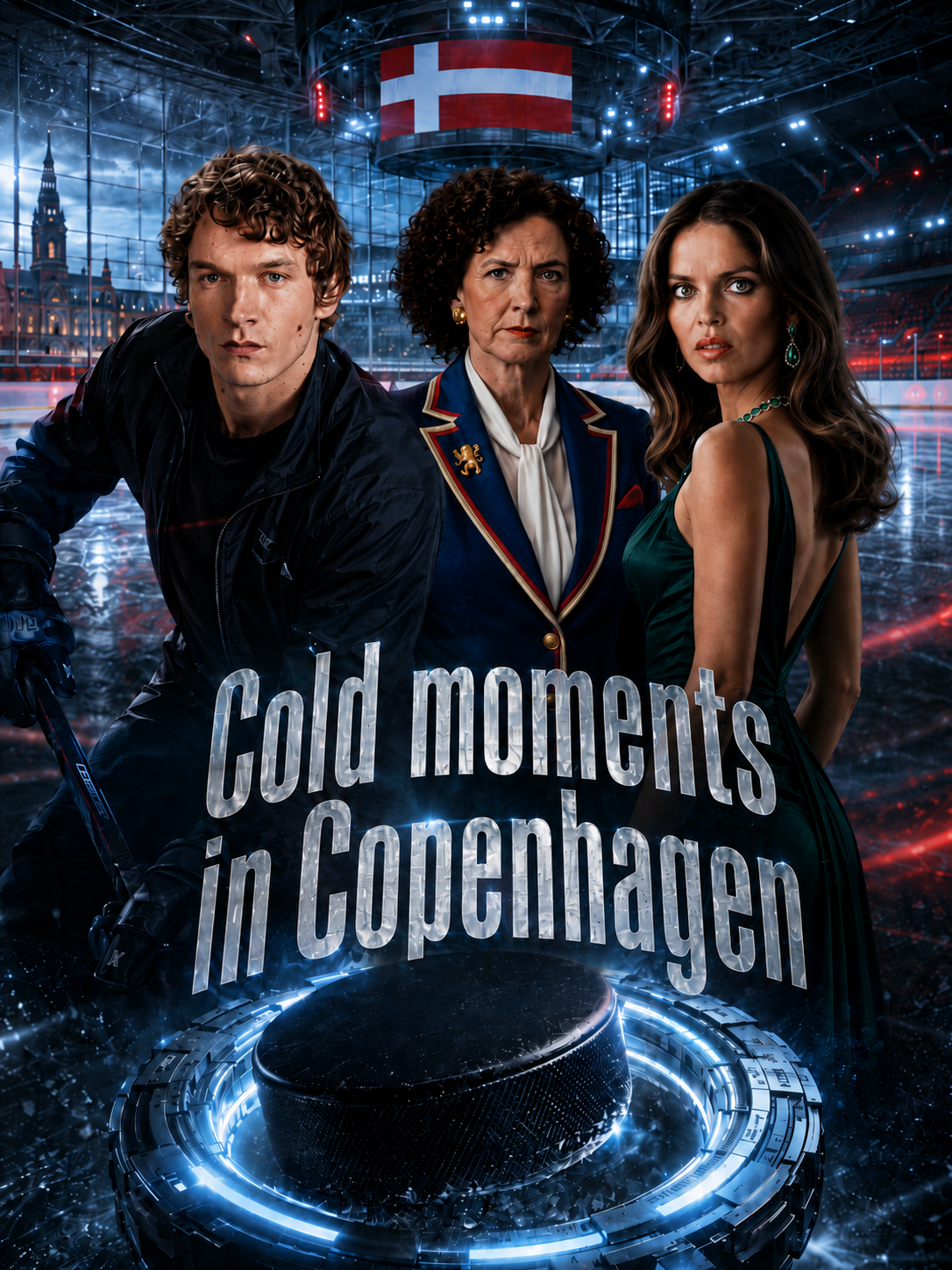
Volume 2: Cold moments in Copenhagen
Following
Table of Contents
The first conquest of Copenhagen The Second Conquest of Copenhagen The Third Conquest of Copenhagen Bearish Appearances The Disappearance Emerald-green seduction at the buffet Anya’s second offer The game in Suite 169 The waiting princess Sex instead of Puck The Entrance The Weapon The Portal Shane’s Rescue Attempt The Cold Comes of Its Own Accord Magnus stumbles into the car park Missing Neptunium Closed Gates The Goods Lift The Compromise Offer A Princess Receives Ilya’s Wish Claudia’s Timetable Anya’s Oily Alternative Ravn’s BanishmentIlya’s Wish
1323
0
0
Please Login in order to comment!
Find your way!
Resources
WHO WE ARE
LEGAL
Listen to our Podcast



by 3 Armored Kittens · Prodromos v.1.1 - World Anvil 0.9.15.050 © 2017-2025 [en] | Anvil Time: 19:01, Sep 10 2026