
Dr Claudia Tiedemann’s intention was to arrive late enough to avoid being photographed.
Outside the main entrance to the Nordhavn Arena, there were still cameras, red strobe lights, Danish flags, elegant guests and every kind of smile. Claudia had little time for such grand entrances; on the contrary, she was actually rather afraid of them. She didn’t like carpets that made people walk more slowly just so that others could look at them.
Her car therefore didn’t stop directly in front of the glass façade, but half a car length further back, at the edge of the cordoned-off drop-off area. The driver wanted to get out, but Claudia had already opened the door.
The wind from the harbour tugged at her coat.
Underneath, she wore a formal outfit that felt more like a costume to her than something she felt comfortable in: a dark blue skirt suit with exaggerated shoulder pads, a white silk blouse, red piping on the collar and cuffs, and a golden brooch in the shape of a stylised Hessian lion. The brooch was heavier than it looked, but the heirloom from her grandmother was her most precious possession.
Her hair was teased into a carefully tamed perm. Claudia knew what she looked like. She also knew that people who underestimated her because of her clothes usually only got the chance to do so once.
A photographer noticed her too late; he nudged his colleague and pointed at her.
“She must be from Bavaria or Baden-Württemberg, judging by the look of her.” His colleague chuckled.
Claudia didn’t look at him. She walked on. She stepped through the revolving door.
Inside, the arena was overwhelming to her, as if someone had persuaded Scandinavian reserve to appear majestic with a great many platinum coins. The ice wasn’t visible from here yet, but you could sense it. An assistant approached Claudia.
“Welcome to the Nordhavn Arena. May I have your name…”
“Dr Claudia Tiedemann. Wiesbaden. Hessian Institute for Nuclear Physics.”
The young woman in the ice-white evening gown blinked.
“Of course. Just a moment.”
She looked at her list. Then at Claudia. Then back at the list, as if the paper could explain to her why a woman with a Hessian lion brooch, a perm and shoulder pads looked like a time traveller.
“You’re registered for the technical presentation after the first programme block.”
“I’m registered for the technical presentation mainly because nobody wanted to give me the documents beforehand.”
“The documents are ready in the guest lounge.”
“Then I’ll go there straight away.”
The assistant smiled helplessly.
Claudia took the accreditation. On the ribbon, written in gold lettering, was:
ENERGY EFFICIENCY / TECHNICAL GUESTS
Beneath it was a small emblem of a bear. Claudia looked at the bear before moving on.
In the foyer, waiters were serving grog, aquavit and small plates of fish, bread and artfully arranged herbs. Images of oceans, Stromberg’s Foundation, happy children and an ice rink that looked far too perfect flashed across the screens. Ladies in long dresses gathered against one wall; their jewellery sparkled so brightly it reached right over to Claudia, which is why she briefly touched her brooch as if it were her personal shield.
One of them spotted Claudia.
“Oh, how lovely! Are you from the Stromberg Foundation too?”
Claudia only stopped because the woman was blocking her path.
“No.”
“From the press?”
“No.”
“Then surely from one of the royal entourages? There’s something very official about that outfit.”
Claudia looked down at herself.
“My mother bought this gown for the party after my graduation. I usually wear a lab coat.”
The woman laughed as if that had been a charming answer.
“I just meant, it’s so wonderfully bold. Those shoulders! You hardly see that anymore.”
A second sponsor joined them. She wore diamonds around her neck and the energetic cluelessness of a woman accustomed to other people finishing her sentences for her.
“Are you here for the match?”
“No.”
“But you know the teams?”
“No.”
“Not at all?”
“Normally I read tables and run a nuclear power station in Hesse.”
“How lovely! But this is a lovely celebration of the oceans, after all; there aren’t any atoms involved.” She burst out laughing and placed her hand on the first lady’s forearm.
Claudia looked towards the glass wall, behind which the inner concourse opened onto the arena.
“I doubt that. The oceans consist mostly of water, a combination of one oxygen atom and two hydrogen atoms.”
“You know, I think it’s so important that female scientists are now visible in society too. It used to be all so dry. But today, with oceans, emotions, young athletes, music—” the first lady tried to bring the conversation back down to earth.
“Reactors don’t become safer if you make them emotional.”
The first sponsor raised her eyebrows. The second sponsor continued to smile bravely:
“And what is a nuclear physicist doing at a charity gala for the oceans?”
“I’m looking for the scientists who will be speaking later about the energy efficiency of this hall. The data released in advance is too fantastic: the tidal power plant beneath the hall, which also fishes plastic waste out of the ocean, is supposed to provide so much energy that it not only cools and lights the hall, but also the neighbouring hotel and Christiansborg Palace, which is why even some noblewoman from the royal family has to turn up here and be grateful.”
“Just some noblewoman? Princess Indulan is a daughter of the reigning Queen Margarethe!” said the first, indignantly.
“They’re over there,” said the second, pointing with relief towards a small group by the panoramic windows. She pulled her friend over to a group of five ladies-in-waiting in ceremonial red evening gowns with velvet fans, standing behind the prospective princess, flanked by four official palace guards and a larger number of security personnel in light-coloured suits scattered around the room.
Claudia nodded, but her “Thank you for that information” went unheard by the two ladies.
By the windows stood five people with glasses of grog that were now only half full. Claudia recognised this immediately as a good sign. Three men, two women.
Claudia stopped at the edge of the group.
The Japanese woman was speaking French.
“The stated reduction in energy consumption is theoretically possible, but not with this thermal load. Not without external compensation.”
“Or without displacement,” said Claudia by way of introduction.
All five turned to her.
The Japanese woman scrutinised her, first the shoulder pads, then the brooch, then the face. Her scepticism did not vanish. She merely became more interested.
“Dr Claudia Tiedemann,” said Claudia. “Hesse.”
The Danish thermodynamician’s face lit up.
“Vestergaard. University of Copenhagen. We’ve read your work on secondary reactor shadows.”
“I tried very hard.”
He laughed in surprise.
The Austrian chemist raised her glass.
“Finally, someone who’s noticed.”
Claudia didn’t take a glass. She looked at the documents in Vestergaard’s hand.
“May I?”
He handed them to her immediately.
That was further proof that she was with the right people here. Stupid people held on to documents because they confused ownership with understanding. Female scientists passed documents on so they could discuss things more quickly. Claudia skimmed the first page.
“This is a glossy technical description. It’s practically a poem with numbers.”
The Frenchwoman smiled.
“A perfect, computer-generated poem from a Danish advertising agency.”
“Do you think energy efficiency can really be increased that much?”
The British engineer leaned forward.
“You mean there could be an additional external energy source? But there are no chimneys, so nothing is being burned.”
“The tidal power station and the solar panels can’t generate enough energy to supply the hall, the hotel and the oversized palace. Especially considering that the solar panels produce nothing at night and actually need to be heated to prevent them from freezing over in the Danish winter.”
Now everyone was smiling.
Claudia almost relaxed. Invisible to the sponsors, but not to the scientists. Her voice quickened. The sport, the cameras, the grog trays and the polite buzz of the gala receded for a moment behind a wall of figures.
“With proximity to salt water, fully heated event areas, an all-electric kitchen and constant lighting, this system cannot operate so quietly, so stably and so economically all at once. Not with the stated heat recovery values.”
“Perhaps external seawater cooling,” said Vestergaard.
“A heat pump would consume vast amounts of electricity, not produce it,” countered the Japanese nuclear physicist, whose dark red kimono rivalled the white trim and sash.
“Deep geothermal energy?” asked the Austrian. “We’ve had great success with that in the Alps over the last ten years.”
“That’s hardly feasible in this configuration. Besides, the whole of Copenhagen would notice someone drilling beneath the harbour and jeopardising the stability of the surrounding buildings.”
The Japanese woman nodded slowly.
“So, high-voltage transmission lines?”
“Could a nuclear reactor on a ship supply the electricity, connected to this hall via an undersea cable?” said Claudia.
The sentence hung in the air.
Outside, the wind lashed against the glass façade. Further back in the foyer, someone laughed too loudly. On a monitor, the image shifted from ice floes to an animation of the arena. A red arrow supposedly indicated the optimised energy flow, before a dean of the Danish National Church uttered a solemn phrase about the preservation of creation and referred to another graphic that was then displayed
Claudia stepped closer to the monitor.
“That’s confusing.”
“What exactly?” asked the Brit.
“The thermal torsion.”
“No, the quantification?”
“It must be an interpolation, for better illustration.”
The Frenchwoman came up beside her.
“Do you see the jump too?”
Claudia really looked at her for the first time.
“What jump?”
The Frenchwoman pointed at the screen. That was clever. She was only looking at the bottom edge of the screen, where a time code was scrolling. 19:42:11. 19:42:12. 19:42:14.
Then 19:42:13 again.
Claudia’s expression didn’t change. But her eyes grew sharper.
“How many times has that happened?”
“Since I’ve been standing here? Three times,” replied the French physicist. “That can’t be a random technical glitch. Perhaps it’s a pattern, a deliberate falsification of the results to stretch the graph and make the efficiency appear higher?”
“Couldn’t that be done more cheaply?” interjected the Japanese woman.
“Who are you?” asked Claudia, surprised.
The Frenchwoman held out her hand.
“Francine de la Motte. World Energy Organisation.”
Claudia took her hand. “Your organisation is acting as patron for tonight’s gala.”
“Energy efficiency is on our agenda. But only if it isn’t simply faked. The Danish royal family has discreetly asked that we share the patronage: national loyalty to the generous Stromberg, which saves the royal family millions in heating and electricity costs for Christiansborg, and international oversight, to which even an international shipping magnate is subject.”
De la Motte laughed softly.
“And you, Dr Tiedemann?”
“I’m here because of efficiency. The power station in Winden is no longer up to date, but Hesse needs more electricity every day. The government’s question now is whether we should modernise the power station, build new ones, or whether cheaper solutions can be found through efficiency savings.” She cast a sidelong glance at the Briton. “Duchess Margaret wouldn’t mind savings if it meant increasing her children’s and grandchildren’s monthly salaries. Or her medical bills.”
Claudia looked back at the monitor. The timecode was now running smoothly. That was precisely why she liked it even less.
“Actually, I’m not dressed for a physical investigation right now.”
The Austrian chemist looked at her shoulder pads somewhat mockingly. “Lise Meitner wouldn’t have looked any better in this. It’s what’s in our heads that matters, not on our shoulders.”
At that moment, the first applause rang out from the hall. On the ice, children in seaweed costumes began to form patterns to the music. The guests moved towards the arena, drawn by the light, by the programme, by the obligation to appear visibly moved.
Claudia stopped for the moment; she looked down at the ice. The surface was immaculate. But then a flicker appeared beneath the surface, like the frozen cry of a man frozen in the middle of the ice. Horrified, Claudia took off her glasses, shook her head and put them back on. The face was gone.
On the opposite side of the concourse, she spotted a woman in a dark green dress, emeralds around her neck, her posture like a weapon beneath silk. Further up, by a balustrade, stood a young man in a black suit with a red shirt and neckerchief, a Soviet player, looking not at the game but at the cold.
Claudia didn’t know why she had noticed them both. But on a night full of celebrities, people who weren’t looking in the right direction were often the first useful data points.
De la Motte stepped up beside her.
“The technical presentation begins after the first programme block. We were told to wait.”
Claudia looked at the monitor display: the time code remained correct.
“Waiting is a political activity,” she said. “Not a scientific one.”
“What do you suggest?”
Claudia adjusted the golden lion brooch on her lapel. The movement was small, but it looked like she was raising a shield.
“First, I’ll listen to how someone explains this energy efficiency. Then I’ll see what you, as a representative of the World Energy Organisation, have to say about it. Only then will I know whether you’re still a scientist or already a politician.”
She looked down at the ice. Below, applause broke out, warmer and louder. The gala had begun. For the first time that evening, Claudia Tiedemann didn’t feel entirely out of place. Only the sport remained a tedious delay that she would endure.
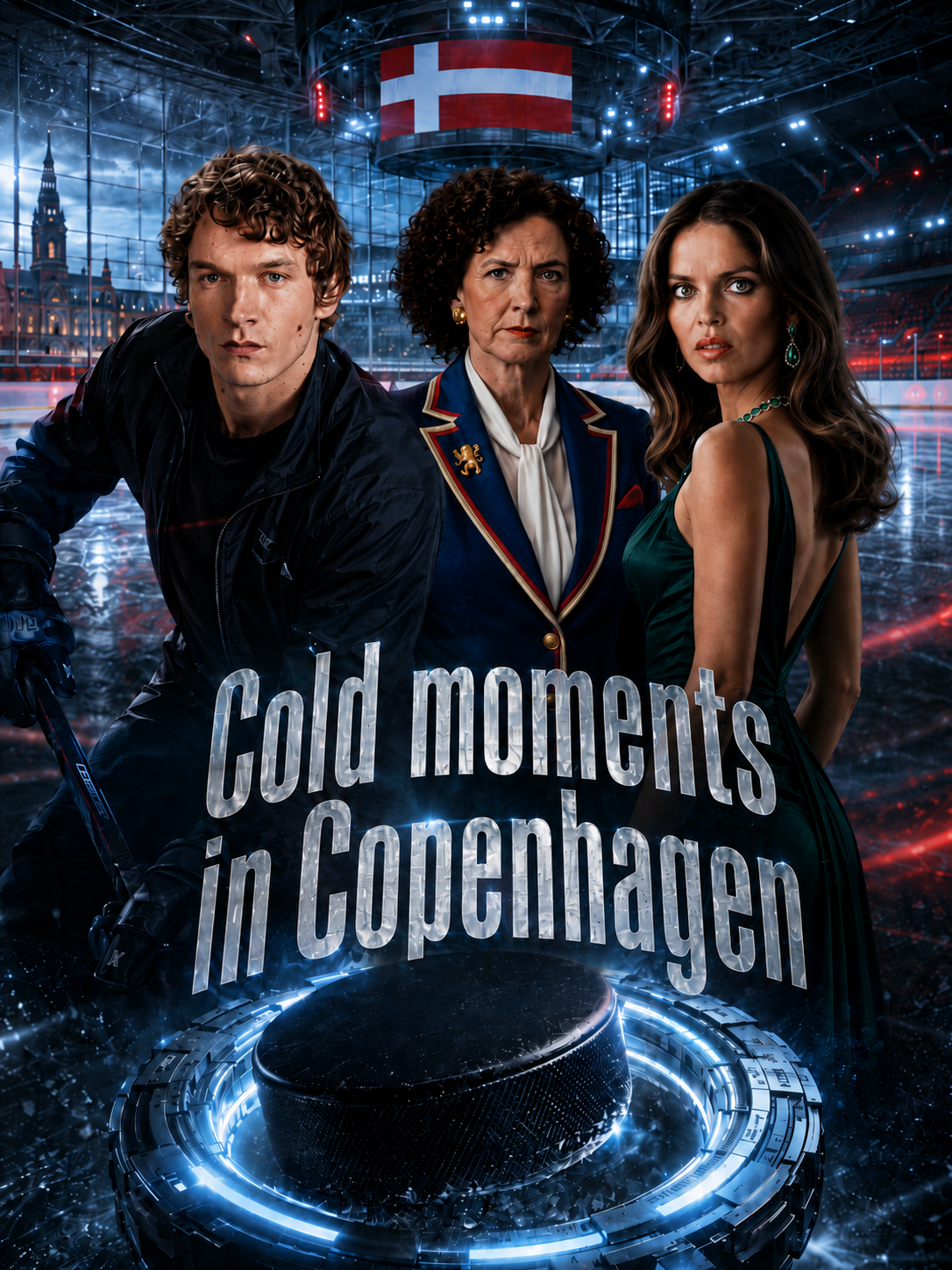
Volume 2: Cold moments in Copenhagen
Following
Table of Contents
The first conquest of Copenhagen The Second Conquest of Copenhagen The Third Conquest of Copenhagen Bearish Appearances The Disappearance Emerald-green seduction at the buffet Anya’s second offer The game in Suite 169 The waiting princess Sex instead of Puck The Entrance The Weapon The Portal Shane’s Rescue Attempt The Cold Comes of Its Own Accord Magnus stumbles into the car park Missing Neptunium Closed Gates The Goods Lift The Compromise Offer A Princess Receives Ilya’s Wish Claudia’s Timetable Anya’s Oily Alternative Ravn’s BanishmentThe Third Conquest of Copenhagen
1307
0
0
Please Login in order to comment!
Find your way!
Resources
WHO WE ARE
LEGAL
Listen to our Podcast



by 3 Armored Kittens · Prodromos v.1.1 - World Anvil 0.9.15.050 © 2017-2025 [en] | Anvil Time: 19:01, Sep 10 2026