
The arena stood by the harbour like a slice of the future made real: glass walls rose above the quay, sloping and immaculate, illuminated from within in shades of blue and white, and from the outside bathed in the red glow of the Danish colours of red and white. Between the steel struts, masts, cranes, the city lights and the black water of the harbour, lapping against the quay wall, were reflected.
Ilya Rozanov paused for a moment in front of the main entrance. He had seen enough arenas, enough new halls, old halls, dilapidated American halls with oversized drink cups, new Soviet halls with LED spectacles instead of homespun mosaics, French halls that smelled of baguettes and red wine everywhere. This hall here was different: it didn’t just want to be sport, but significance.
A banner hung above the entrance:
STROMBERG GALA FOR THE PROTECTION OF THE OCEANS
COPENHAGEN — 13 FEBRUARY 2026
Beneath it were smaller lines in Danish, English, French, Japanese, Ottoman and Russian. The Russian was neatly typeset, without the usual errors. Someone had spent money to ensure this night could shine in multiple languages.
Ilya pulled the collar of his dark coat higher and stepped through the revolving door.
Warmth, perfume and damp leather hit him. In the arena’s foyer stood reception desks of white stone, behind which young women in ice-white evening gowns with dark red silk scarves checked names. Waiters carried trays with small glasses, their stems shaped like stylised polar bears, in which clear aquavit glistened like melted ice. A row of flags hung on one wall: Denmark, the United Nations, the World Energy Organisation, and above them all, the company flag of the Stromberg Shipping Line.
Ilya gave his name.
The woman at reception smiled professionally.
“Mr Rozanov. Welcome to Copenhagen. Your pass grants access to the Arena, the guests’ lounge and the hotel transfer. You will receive an access card that opens the relevant security lock. Your luggage has already been taken to your suite at the Arena Hotel. The buffet will also take place there after the gala. Mr Stromberg is delighted that you will be attending as a representative of your team.”
“Of course,” said Ilya.
He said it in a way that sounded like agreement but tasted like a lie.
She handed him a card on a red ribbon. A stylised bear was embossed on the card, not menacing, but rather heraldically tamed: golden claws, white body, blue outline. Ilya turned the card briefly between his fingers.
“A bear?”
“The theme of the evening,” said the woman. “Mr Stromberg has specially brought over a year group from the Leopoldine Military Grammar School in Austria, who will be presenting a literary piece.”
Ilya looked at her.
“In the middle of the school year? Mr Stromberg must have some good connections. Are cadets into literature now?”
Her smile faltered.
“He treated the year group to a week-long excursion in Denmark to rally them for the protection of the seas. Their performance today is in return.”
Ilya took the card and walked on.
The floor beneath his shoes was polished black, criss-crossed with white lines, as if someone had translated the markings of an ice rink into marble. Red strips of light hung above it. In the glass walls, the city moved along as a reflection: Copenhagen outside, Copenhagen inside, both separated by a transparent surface.
Ilya didn’t like evenings like this.
Not because he felt uncomfortable in a tuxedo. He looked good in anything expensive enough to seem inauthentic. Not even because of the sponsors, ministers, former sports officials and diplomatic guests standing in small groups, laughing as much as their status allowed. He didn’t like evenings like this because ice wasn’t allowed to be just ice here. Ice was a stage, proof, a metaphor, an investment, a charitable cause. No one let it simply be.
He stopped at the balustrade from which one could look down into the hall.
The ice rink lay deep below him, smooth and bright, cut by streaks of red light. The stands rose up darkly, still half-empty, but already waiting. Above the centre of the rink hung a circular ring of light, on which images of oceans, whales, melting glaciers and cheering children played in slow succession. A promotional film with a guilty conscience and good editing.
Ilya closed his eyes and remembered another ice rink. Chestnut Mountains. The old smell was back, even though it couldn’t really be there: cold dust beneath the stands, damp wool, musty metal full of rust and asbestos, stale coffee, the sour cleaning product of a rink that hadn’t been properly clean since 1947. Flashbulbs on ice. Voices behind him. Shane Hollander, too controlled, too upright, trying too hard not to show that anything affected him.
He pressed his thumb and index finger against the edge of his access card. The little golden bear dug into his skin.
“Bad journey?”
Ilya turned round.
A woman in an ice-white suit stood a few steps behind him. She was blonde, slender, very upright, with a smile that wasted no warmth. Her jewellery was understated, but not modest: narrow diamond earrings, a white-gold bangle, a brooch in the shape of a stylised wave.
Signe Ravn.
He knew her name from the invitation. Event manager, Stromberg Foundation, Copenhagen Coordination, officially responsible for protocol and guests. Unofficially, a woman like Signe surely looked after everything that was too expensive to be recorded in the paperwork.
“My journey was excellent,” said Ilya. “I’d just forgotten how much I love charity work. Thank you for the invitation after the match.”
Signe smiled a little more.
“We’re delighted to be able to convey the value of the oceans to everyone, regardless of day-to-day politics: the Socialist Assistance Pact, the Continental Defence Community, the Commonwealth Defence Pact, the Pan-Asian Pact and the Sword of Islam Pact are standing together on the ice today, rather than scheming against one another. So tonight you’re among friends.”
“That’s usually what people say who aren’t.”
“And yet you’ve come.”
“I like playing charity matches. The party and my father approve.”
Her gaze remained fixed on his face. She wasn’t sizing him up conspicuously. Amateurs did that. She took note of him, categorised him, filed him away. Sports star. Russian. Most recently in the US with Shane Hollander, hero of a murder investigation. Emotionally unreliable, a womaniser with no fixed ties, but useful in public. Perhaps dangerous if offended. Certainly decorative.
Ilya knew that look. He’d received it from coaches, officials, lovers and enemies. One just had to figure out which category was lying at that moment.
“Mr Stromberg is delighted to have you here,” said Signe.
“That’s nice for Mr Stromberg.”
“And for marine conservation.”
“The sea must be quite choppy.”
Signe tilted her head, as if he’d offered her a bit of light-hearted banter, not an insult.
“You’ll find that this evening is more than just a charity match.”
“I’m afraid so.”
Behind Signe, two men in ice-white suits walked past. They carried no visible weapons, but moved as though they’d rarely carried trays in their lives. One spoke quietly into a microphone on his sleeve. The other didn’t look directly at Ilya, but was watching him nonetheless.
Signe stroked his shoulder and grinned.
“Security protocol,” she said.
“For whales?”
“For guests.”
“I’m a guest.”
“That’s precisely why I’m being watched.”
She let the word hang in the air and walked on.
Ilya watched her go.
On the ice, a technician began checking the light markers for the upcoming performance. Red circles glided across the ice, vanished, then reappeared. For a moment, the surface seemed not to be lit, but to be being measured.
That bothered him. As an athlete, anything that turned an ice rink into a dance stage bothered him. But this was different. The cold in the hall was uneven. Up by the railing it was too warm, down by the ice too biting. It was an unusual draught, almost like a boundary.
Ilya leaned forward slightly.
A light mist lay directly over the ice surface. He thought of Chestnut Mountains. Of the old hall, threatened with demolition, where things lay beneath the surface.
Of blood, which looked different on ice than it did on the ground.
Of Shane, who always tried to keep control, even when everyone else had long since seen that control was nothing more than a façade. For a moment he thought of those four days in the snow-bound Hart Chalet, but immediately brushed the thought aside, because today he had to win for the Socialist Assistance Pact on the battlefield of ice.
Shane himself now appeared on the video ring. A pre-recorded clip: Shane in training gear, his face calm, his voice polite, his words perfectly tailored for sponsors.
“Protecting the oceans,” said Shane on the screen, “means taking responsibility for future generations.”
Ilya laughed quietly, even though it was wrong. Because Shane could just as easily have said, with the same professionalism and smoothness, that nuclear waste could safely be dumped into the sea, as it was deep enough for that.
An elderly Danish gentleman with a medal ribbon stopped beside Ilya and looked at the screen too.
“An impressive young man,” he said in English.
“Yes,” said Ilya. “He practises a lot.”
“Do you know him?”
Ilya looked down at the ice.
“Sometimes.”
The man didn’t understand a word, but nodded as if that were precisely what was so socialist.
On the other side of the foyer, doors opened. A small group of Austrian cadets was led in, standing very straight, in uniforms that looked as though they came from a world where education still smelled of discipline, of gold and lilac. One of them was carrying a folder. On the cover, in golden letters, it read:
BEAR YEAR
Ilya looked down at his access card again.
The Bear wasn’t smiling. A bear never smiled. People just liked to tell themselves that teeth were friendly, as long as they were made of gold.
A gentle gong sounded over the loudspeakers.
A voice announced the start of the reception programme, first in Danish, then in English, French and Russian. The Russian remained flawless. No mistakes again. Enough money again for good speakers.
Ilya took a glass of aquavit from a tray but didn’t drink from it yet.
He looked into the hall. On the ice, red light swept across the white surface. Water outside. Ice inside. Flags above. People in between, who believed they could decide what was allowed to melt.
At the other end of the glass corridor, he saw Shane for a moment, this time not on the screen but in the flesh.
Shane was standing with two officials who were shaking his hand as if his healed shoulder already belonged to an association, a league, a foundation. He was wearing a dark suit and looked too handsome in it for this sort of evening. Then he looked up, as if he’d sensed Ilya.
Their eyes met across the distance.
Chestnut Mountains was suddenly back, not as a place, but as an unresolved issue.
Shane looked away before anyone noticed.
Ilya smiled before downing the aquavit in one go. It barely burned. That was suspicious.
As he set the glass down, the light above the ice rink flickered. Just once. So briefly that most of the guests carried on talking.
But down on the ice, a dark circle remained for a breath of a moment where there shouldn’t have been one.
Ilya saw it as the distorted grimace of a Nordic ice demon that had been pressed beneath the surface.
Then it was gone.
The hall was already applauding the first announcements, the flags, the oceans, itself.
Ilya stood by the railing and thought that the night hadn’t started cold enough.
That was almost always a bad sign.
Ilya no longer noticed that the video ring was now displaying his written contribution, in which he dutifully read out that the protection of the seas had already been envisaged by Karl Marx and was a central socialist concern.
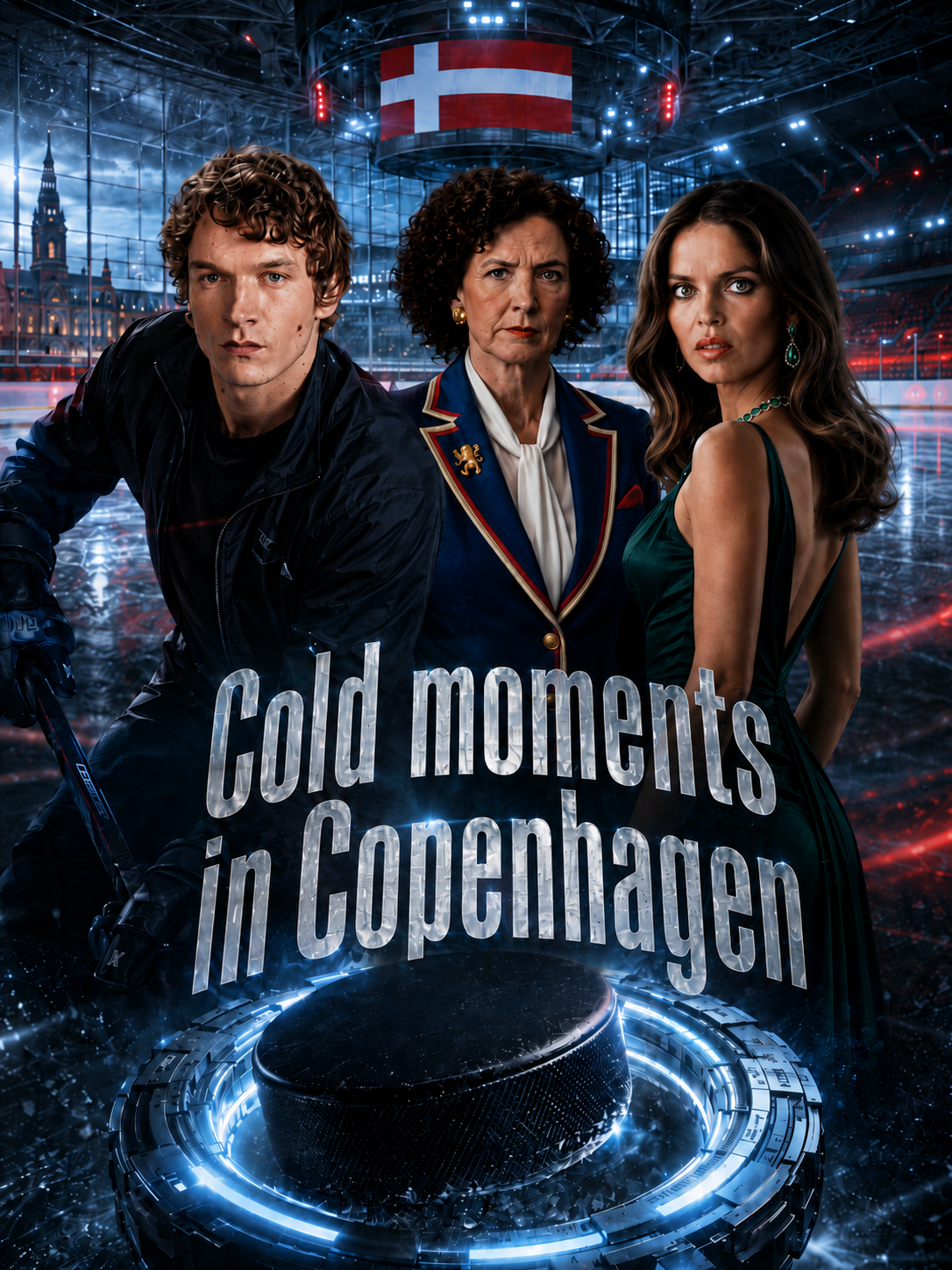
Volume 2: Cold moments in Copenhagen
Following
Table of Contents
The first conquest of Copenhagen The Second Conquest of Copenhagen The Third Conquest of Copenhagen Bearish Appearances The Disappearance Emerald-green seduction at the buffet Anya’s second offer The game in Suite 169 The waiting princess Sex instead of Puck The Entrance The Weapon The Portal Shane’s Rescue Attempt The Cold Comes of Its Own Accord Magnus stumbles into the car park Missing Neptunium Closed Gates The Goods Lift The Compromise Offer A Princess Receives Ilya’s Wish Claudia’s Timetable Anya’s Oily Alternative Ravn’s BanishmentThe first conquest of Copenhagen
1303
0
0
Please Login in order to comment!
Find your way!
Resources
WHO WE ARE
LEGAL
Listen to our Podcast



by 3 Armored Kittens · Prodromos v.1.1 - World Anvil 0.9.15.050 © 2017-2025 [en] | Anvil Time: 19:01, Sep 10 2026